HIGH SALIENCE / GUIDES / CHATGPT SHOPPING
GUIDE · SEPTEMBER 26, 2026
ChatGPT Shopping: How ChatGPT Picks Products, and How Merchants Get Listed
ChatGPT shopping is the product layer inside ChatGPT: when someone asks what to buy, ChatGPT can show specific products with prices and places to buy them. OpenAI says those results are not paid. They come from product feeds and from what ChatGPT reads on the web, and in 2026 OpenAI changed direction on how purchases happen. Here is how it works now and what merchants can do.
BY BIKE HAWLEY, FOUNDER · PUBLISHED · UPDATED

01How It Works
How ChatGPT picks products
OpenAI's shopping help article says product results are selected independently by ChatGPT and are not ads. Selection weighs:
- relevance to the question and the user's context, including memory and custom instructions if they are on;
- structured product data from first- and third-party providers, such as price, description and reviews;
- safety policies.
When several merchants sell the same product, OpenAI says it ranks them by factors like availability, price, quality, and whether the merchant is the maker or primary seller.
02Timeline
What happened to ChatGPT Instant Checkout?
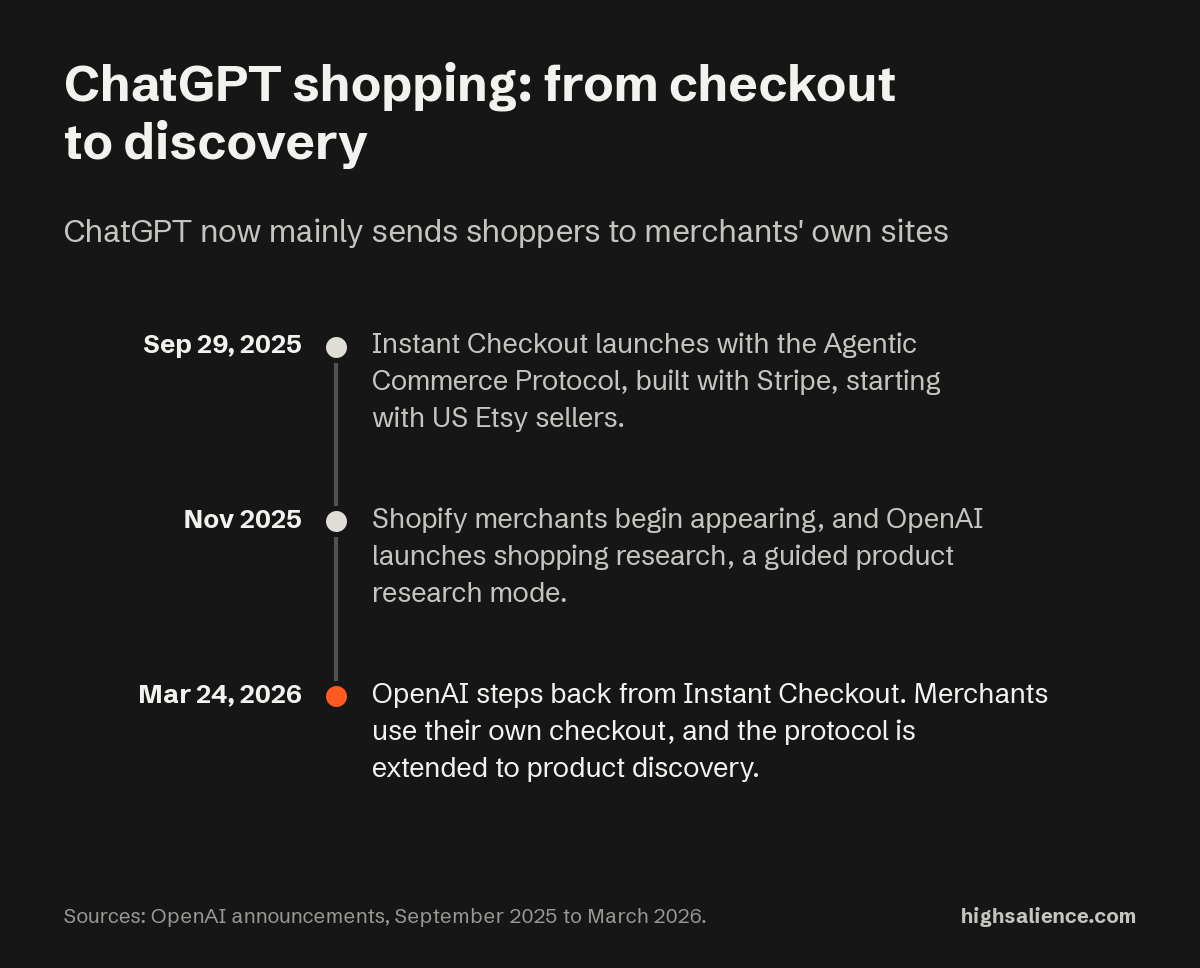
ChatGPT shopping changed course, from Instant Checkout inside ChatGPT to product discovery that sends shoppers to merchants' own sites.
- September 29, 2025: OpenAI launches Instant Checkout with the Agentic Commerce Protocol, built with Stripe, starting with US Etsy sellers.
- November 2025: Shopify merchants begin appearing, and OpenAI launches shopping research, a guided product research mode.
- March 24, 2026: OpenAI steps back from Instant Checkout, saying the first version was not flexible enough. Merchants now use their own checkout, the protocol is extended to product discovery, and large retailers including Target, Best Buy and Home Depot are integrated. Shopify merchants are covered through Shopify Catalog.
The upshot for merchants: ChatGPT is now mainly a discovery channel that sends shoppers to your site, not a marketplace that takes the sale.
03Our Data
Which sources ChatGPT cites for product recommendations
Product feeds decide what ChatGPT can show, but what it recommends depends on the sources it reads. In our four-industry study, we asked ChatGPT 25 common product questions, from running shoes to cookware. Its most-cited sources were product testing publishers: RTINGS, WIRED, Tom's Guide and Good Housekeeping. Only 24 percent of the sites it cited ranked in Google's top ten for the same question.
Google handled the same questions differently: its AI Overviews linked to Google's own product listings in 21 of 25 answers. Shopping visibility now means two feeds (Google Merchant Center and OpenAI's) and a presence in the reviews each system reads. We cover the full picture on our ecommerce page.
04How To
How to get your products into ChatGPT
Getting your products into ChatGPT starts with a product feed, then accurate data and honest reviews.
- Submit a product feed. Apply at chatgpt.com/merchants. OpenAI's commerce documentation sets out the feed format, and it can accept a Google-compatible feed once confirmed for your account.
- On Shopify? OpenAI says Shopify merchants are included through Shopify Catalog without extra work. Check that your catalog data is complete.
- Keep data accurate. Availability and price are ranking factors. Out-of-date feeds lose to sellers with current data.
- Earn independent reviews and tests. The publishers ChatGPT cites decide which products it calls best. Get your products in front of them.
- Do not fake reviews. The FTC's rule banning fake reviews, including AI-generated ones, took effect in October 2024.
For stores that want help with feeds, reviews and the pages ChatGPT reads, we work as an AI search agency for ecommerce.
05FAQs
ChatGPT shopping FAQs
These ChatGPT shopping FAQs answer what merchants ask about product results, checkout and feeds.
Are ChatGPT product results ads?
ChatGPT product results are not ads, according to OpenAI, which says ChatGPT selects them independently. Ads in ChatGPT are separate, labeled placements below the answer.
How does ChatGPT choose which products to show?
OpenAI says ChatGPT chooses which products to show by weighing relevance to the question and the user's context, structured product data from first- and third-party providers, and safety policies. Merchants are ranked by factors like availability, price, quality and whether they are the maker or primary seller.
Can people buy directly in ChatGPT?
Buying directly in ChatGPT is now the exception. OpenAI launched Instant Checkout in September 2025, then scaled it back in March 2026. Shoppers now go to the merchant's own site by default, and OpenAI focuses on product discovery. Instant Checkout may still appear for some eligible products.
How do I get my products into ChatGPT?
To get your products into ChatGPT, apply at chatgpt.com/merchants to share a product feed. Shopify merchants are included through Shopify Catalog. Beyond the feed, the reviews and product tests ChatGPT cites shape which products it recommends.
06Sources
Sources and further reading
07Next Step
See what ChatGPT and Google recommend in your product category
Every High Salience engagement starts with the Category Salience Brief, which shows what ChatGPT and Google recommend in your product category: your commercial questions run across Google and the AI surfaces, competitors side by side, and a ranked list of what to fix first.