HIGH SALIENCE / BLOG / ENTITY SALIENCE
BLOG · ENTITY SEO
Entity Salience: What It Is, How It Is Scored, and What It Means for SEO
Entity salience is how central a person, company, place or thing is to a piece of text, scored from 0 to 1.0 by Google's Natural Language API, and what it means for SEO is narrower than many guides suggest. The score is a good check on whether a page is clearly about what you think it is about. But Google has not confirmed it as a ranking factor, the newest version of the API does not return it, and the public demo does not show it. Here is what it measures, how to check it now, and what 1,050 ChatGPT answers show about where AI answers put the brands they pick.
BY BIKE HAWLEY, FOUNDER · PUBLISHED · UPDATED

High Salience is an AI search and SEO agency; this post explains the word our name comes from.
01Definition
What is entity salience?
Entity salience means the importance of one entity, such as a brand, product, person or place, to the text it appears in. Google's Natural Language API gives every entity it finds a salience score between 0 and 1.0, which its reference documentation describes as the importance or centrality of that entity to the entire document text.
Research on entity salience offers a plainer test: an entity is salient if a good summary of the text would have to mention it. Google researchers built a large dataset for the task that way in 2014, marking an entity in a New York Times article as salient when the article's human-written abstract also named it, as their research blog post explains.
Salience belongs to a text, not to an entity: your brand can be the main subject of your homepage and a passing mention on a competitor's comparison page. For the word's other senses, see what salience means; our glossary has the short definition.
02The Score
How the salience score works in Google's Natural Language API
The salience score in Google's Natural Language API works inside one text: every entity the API finds in a document gets a number between 0 and 1.0, and scores closer to 1.0 are more salient. It is not a count of mentions. A sample response in Google's Natural Language basics guide shows why: in four short sentences about music, R&B music is named once and scores 0.53, while Marvin Gaye is named twice and scores 0.22.
Google's documentation explains what the number means, not how the model arrives at it. Version 1 of the API also links an entity to its Wikipedia page and Knowledge Graph ID when it can, which shows whether it matched a name to a known entity. Version 2 does not return salience at all: when Google made it available in August 2023, its release notes said entity analysis had moved to a new PaLM-based model and listed "No salience field."
03Research
How entity salience is computed
Entity salience is computed by a model trained to predict which entities matter to a text. The clearest public account of such a model is a 2014 paper by Jesse Dunietz of Carnegie Mellon University and Dan Gillick of Google Research; it does not describe Google's API, but it shows what a salience model looks at.
Their labels used the summary test: across 110,639 New York Times articles, an entity counted as salient if the abstract also mentioned it, which marked about 14 percent of 2.2 million entities. A baseline that called every entity in the first sentence salient reached an F1 score (a standard measure balancing precision and recall) of 46.2. Their full model reached 62.0, a 34 percent improvement by the authors' count, using signals like these:
- Position. The sentence in which the entity is first mentioned. In news, the authors note, sentence position is a very strong indicator of relevance.
- References, not repeats. Counting every reference (names, descriptions such as "president" and pronouns such as "he") predicted salience better than counting repeats of one word: an F1 of 54.1 against 44.4.
- The headline. Whether the words used for the entity also appear in the headline.
- Related entities. An entity named once can still be central if it is closely tied to the rest of the article, though this signal added only a small gain.
Later work kept the summary test. GUMsley, a 2024 dataset covering 12 genres of English, marked an entity salient if a human-written summary mentioned it, and only about 7 percent of entities qualified: most of what a text names is not what it is about.
04How To
How to check entity salience
To check entity salience, use version 1 of the Natural Language API. The demo on Google's Natural Language product page, which many SEO guides point to, sends text to version 2 as of September 2026, so it shows no salience score. These routes return it:
- The gcloud command line tool. Google's command reference says
gcloud ml language analyze-entitiesuses the v1 API; add--content-filefor a saved file and--content-type=htmlif it is HTML. - The v1 analyzeEntities method. A POST request to the v1 endpoint returns each entity with its salience, and the method's reference page has a Try it panel.
- The free tier. Entity analysis is free for the first 5,000 units a month, and a unit covers up to 1,000 characters, so a handful of test pages fits inside it.
Test the main text of a page, not the whole HTML file, so you measure the article rather than the menus. Then read the result as an order: the entity the page is about should outscore every other entity on it.
05Rankings
Salience in SEO: what it does and does not mean for rankings
Salience in SEO is best used as a writing check, not a ranking target. Google has not confirmed entity salience as a ranking factor, its guide to Google Search ranking systems does not mention salience, and the score people test comes from a Google Cloud API sold to developers, not from Search.
The score is still useful. When the entity a page is meant to be about scores low, look for the causes the research points to: the entity appears late, the text refers to it inconsistently, or another entity takes the headline and the opening. Fixing those makes the page clearer to readers and to any system working out what it is about, which is the practical core of entity SEO.
What the score cannot tell you is whether a page deserves to rank. A page can be entirely about your brand and still be thin.
06Original Data
Salience in search marketing: what AI answers show
Salience in search marketing now covers AI answers too, and they show a pattern the 2014 research would recognize: when an answer's opening sentence names a brand, it is almost always one the answer picks. In September 2026 we asked ChatGPT, with web search on, 100 buyer questions in each of 21 software categories, and two AI readers coded which brands each answer named and which it picked as its own choice.
Across the 1,050 answers to category searches and situation questions (30 and 20 per category), 322 opening sentences named at least one brand on our list for that category, not counting brands named in the question itself. Of those, 303 (94%) named a brand the answer picked. Brands ChatGPT named without picking reached the opening sentence in 43 of their 1,177 appearances (4%); its picks did in 645 of 3,593 (18%).
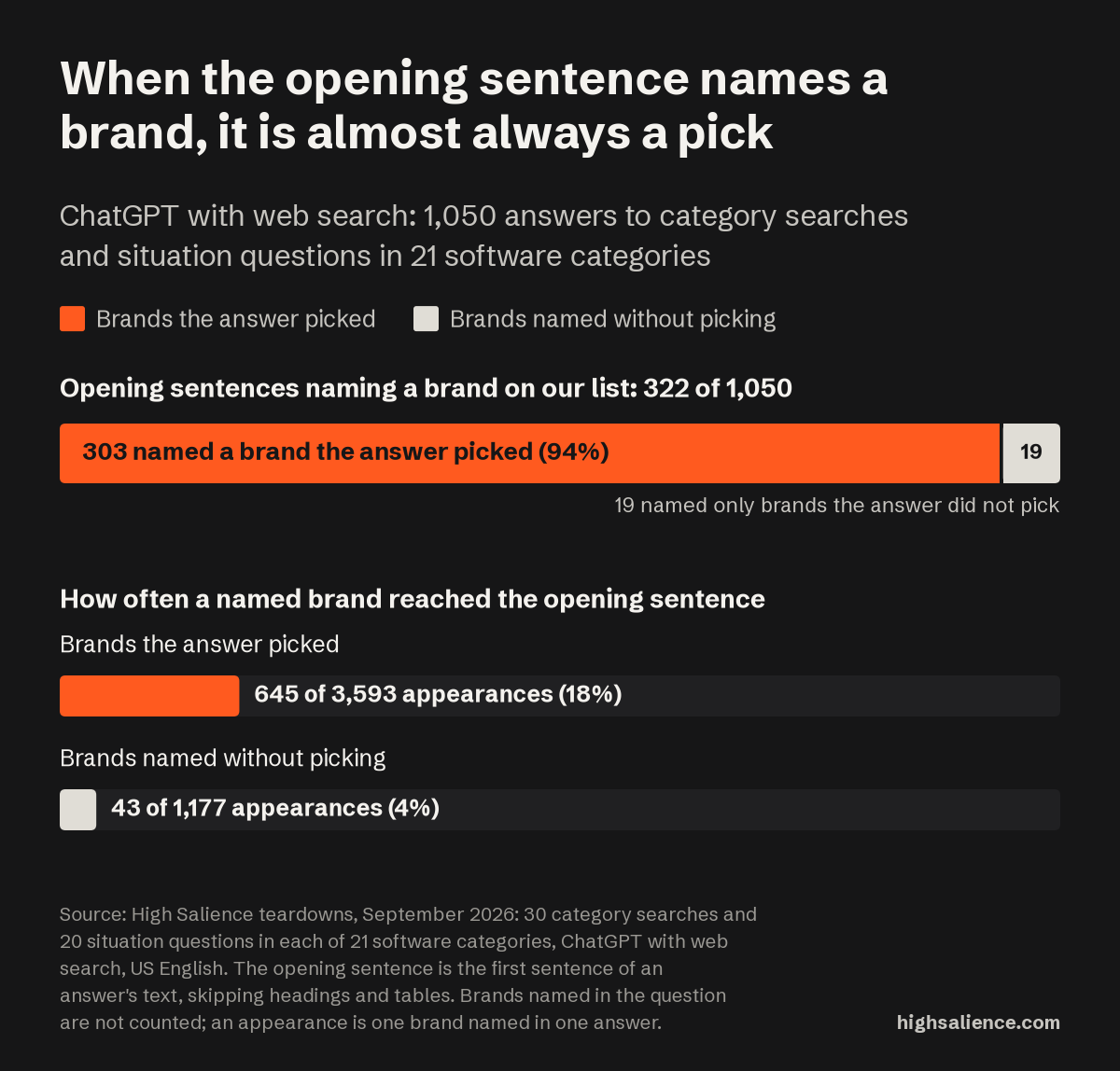
This is a position count, not a salience score; we did not run the answers through Google's API. Research on AI summaries adds a caution: in GUMsley, summaries from current models, including GPT-4 prompted with no examples, missed many entities that human summaries kept, and supplying the salient entities produced better summaries.
For a brand, being what an AI answer is about is closer to brand salience, the marketing idea, than to the API score. We measure it across Google and AI answers with the Category Salience methodology, the questions and codes behind these counts are published with each teardown in our research, and raising it is the work of our AI search visibility practice.
07FAQs
Entity salience FAQs
Each of these entity salience FAQs gets a short answer, from what counts as a good score to whether salience is a Google ranking factor.
What is entity salience in simple terms?
Entity salience, in simple terms, is how much a text is about a particular person, company, place or thing. If a short summary of the text would have to mention it, it is salient.
What is a good salience score?
A good salience score has no official threshold. Google's documentation says scores closer to 1.0 are highly salient and gives no cutoff, so compare within the page: the entity the page is about should score higher than every other entity on it.
Is entity salience a Google ranking factor?
Entity salience is not a confirmed Google ranking factor. Google's guide to its Search ranking systems does not mention salience, and the score SEOs test comes from Google Cloud's Natural Language API, a product for developers.
Does Google's Natural Language demo show salience?
Google's Natural Language demo does not show a salience score as of September 2026, because it sends text to version 2 of the API, which has no salience field. Use version 1 through the gcloud tool or the analyzeEntities method.
Is entity salience the same as relevance?
Entity salience is not the same as relevance, though the two are related. Salience compares the entities inside one text; relevance, in Google's description of how Search works, is about whether a page has information that matches what the searcher is looking for.
08Sources
Sources and further reading
- Dunietz and Gillick (2014), A New Entity Salience Task with Millions of Training Examples, EACL
- Lin and Zeldes (2024), GUMsley: Evaluating Entity Salience in Summarization for 12 English Genres, EACL
- Google Cloud: Natural Language API v2 Entity reference (no salience field)
- Google Cloud: Natural Language AI product page and demo
- Google: How Search works, ranking results
09Next Step
See how central your brand is to Google and AI answers
Every High Salience engagement starts with the Category Salience Brief, which shows how central your brand is to the answers in your category: your commercial questions run across Google and the AI surfaces, competitors side by side, and a ranked list of what to fix first.