HIGH SALIENCE / RESEARCH / HELP DESK TEARDOWN
TEARDOWN 04 · PUBLISHED SEPTEMBER 17, 2026 · DATASET INCLUDED
100 Questions, Fourth Category: Help Desk, Where a Site Nobody Knows Is the Third Most-Cited Source
Fourth category, same method: 100 help desk and customer support queries, ChatGPT with web search on, every answer coded under the rulebook the first three teardowns used, Google's top ten as a control. Zendesk leads the way Asana did, the vertical prompts did not swap the field, and the third most-cited source in the whole dataset is a site we had to look up.
01Method
Same query structure, same coding, one new category.
Queries: 100 help desk software queries built from the same templates as the earlier teardowns: 30 category, 30 comparison, 20 alternative and 20 recommendation. The full list is in the dataset.
Surface: ChatGPT with web search forced on, logged out, United States, English, via the DataForSEO scraper, one run per query, collected September 17, 2026.
Control: Google's top ten organic results for the same queries in the same window, via the DataForSEO SERP API at depth 20 and truncated to the first ten organic results.
Coding: every brand named was coded as recommended (selected for a stated case), listed (in a table or list without being chosen), passing, or anchor (the brand being replaced in an "alternatives" query), against a 56-brand dictionary fixed before collection, under codebook v1.5. Cited URLs were deduplicated to their domain and classed as first-party or third-party. Five answers drawn with a fixed seed were hand-checked: 25 coded mentions, 23 agreed with the reader. Both disagreements were hedged picks ("good if you primarily need email tickets", "better if you expect a larger operation") that the rulebook codes as listed; they are left in and reported.
One run per query, so this is a teardown, not the benchmark. Frequencies describe this window only. Absence means not observed in this sample, never zero visibility.
02Findings
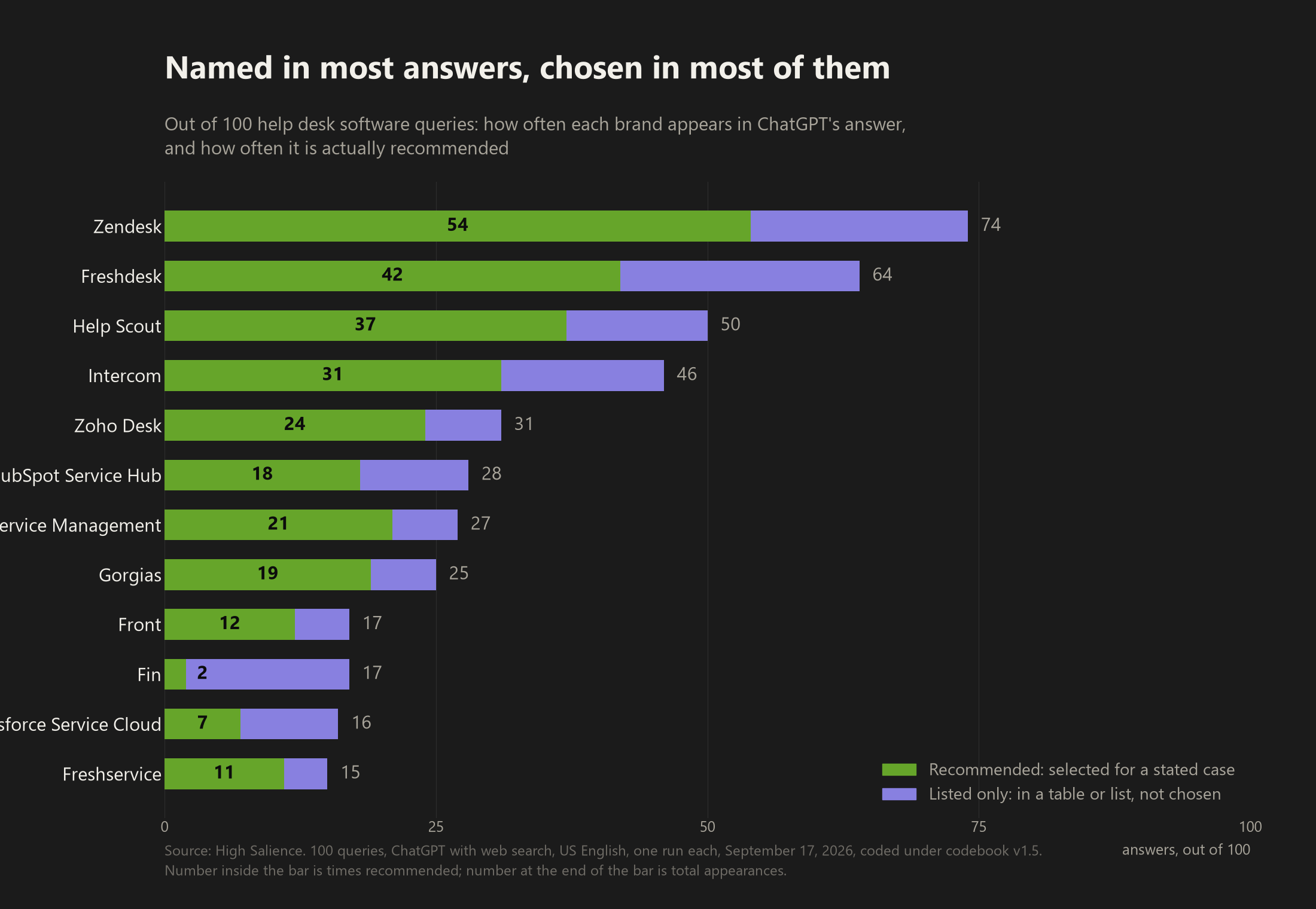
Named in most answers, chosen in most of them.
| Brand | Appears in | Recommended in | Recommended share of appearances |
|---|---|---|---|
| Zendesk | 74 | 54 | 73% |
| Freshdesk | 64 | 42 | 66% |
| Help Scout | 50 | 37 | 74% |
| Intercom | 46 | 31 | 67% |
| Zoho Desk | 31 | 24 | 77% |
| HubSpot Service Hub | 28 | 18 | 64% |
| Jira Service Management | 27 | 21 | 78% |
| Gorgias | 25 | 19 | 76% |
| Front | 17 | 12 | 71% |
| Fin | 17 | 2 | 12% |
| Salesforce Service Cloud | 16 | 7 | 44% |
| Freshservice | 15 | 11 | 73% |
Out of 100 answers, codebook v1.5. "Recommended" means the answer selected the brand for a stated case. "Appears" adds brands listed in a table or bullet list without being chosen. The brand being replaced in an "alternatives" query is excluded from both columns.
Zendesk leads, and the field is deep
Zendesk is named in 74 answers and recommended in 54. Freshdesk is named in 64 and chosen in 42, Help Scout 50 and 37, Intercom 46 and 31. That is a leader with a clear gap, as in project management, but with a longer competitive tail: Zoho Desk, HubSpot Service Hub, Jira Service Management and Gorgias are each named in 25 to 31 answers and chosen in most of them. Category queries average 6.1 brands per answer, the most of the four categories so far, and 3.8 recommendations. Fifty-four answers recommend three or more brands.
Intercom's Fin AI agent is a special case: it is named in 17 answers as a feature of Intercom and chosen as a product in its own right in 2. Freshworks' Freddy AI shows the same pattern, named in 10 and chosen in 2. The AI agent is what the model talks about; the help desk is what it recommends.
When asked for a pick, Help Scout wins the small-team lane
Eighteen of 20 recommendation-intent queries produced a dictionary pick. Help Scout and Zendesk were each among the picks in 11 of them, Freshdesk in 9, Intercom in 8, Zoho Desk and Jira Service Management in 5 each. Only two of the 18 produced a single pick, and both are lanes: the solo founder gets Help Scout alone and the software startup gets Intercom alone. Everything else is a fork of three to six brands, Help Scout for the smaller team, Zendesk or Jira Service Management for scale, Gorgias for the store, Freshservice for the IT department. The two queries with no dictionary pick were "client work" and "a team that uses Slack", both answered with a table and a request for context.
Twenty-eight forks, one winner, one refusal
In 28 of 30 head-to-head queries ChatGPT recommended every brand named in the query. Freshservice versus ServiceNow produced a single winner, Freshservice, on the grounds of simplicity and speed to deploy, with ServiceNow kept for large, complex enterprises. HelpDesk versus LiveChat produced no pick at all.
The vertical prompts did not swap the field
Schools, healthcare, law firms, a real estate brokerage, MSPs, IT teams: every one of those prompts still produced a recommendation from the general dictionary. That is the first category of the four where a vertical word did not erase the general brands. Help desk software appears to be read by the model as horizontal in a way that CRM and project management are not.
Three quarters of recommendations go to brands that do not rank
Of the 336 recommended brand mentions, 255 were for brands whose own website does not rank in Google's top ten organic results for that query, 76 percent. Google's top ten for these queries is 71 percent third-party pages. Between the four categories the figure now runs 65, 70, 76 and 83 percent.
The third most-cited source is a site called Macha
Across 100 answers there were 345 citation events to 113 domains, one per cited domain per answer. Zendesk.com leads with 32 and intercom.com follows with 21. Third is getmacha.com, cited 20 times, ahead of freshworks.com (18), G2 (15), helpscout.com (12) and gorgias.com (12). Macha is a vendor blog whose comparison posts (best free Zendesk alternatives, Freshdesk versus Help Scout versus Zendesk, cheaper Intercom alternatives) the model cited in 20 answers across all four intents. Behind it are commsadvisor.com (7), getomnichannel.com (6), interobservers.com (5), stackbriefly.com (5) and toolradar.com (5). Forty-six percent of citation events went to third-party sites that are neither review platforms nor recognized publishers, tied with CRM for the highest share so far, and only 44 percent went to vendors' own sites. Reddit and Wikipedia have zero citations, for the fourth teardown running.
Eighty of the 345 citation events involved a domain that also sat in Google's top ten for that query, 23 percent.
034 categories, side by side
Same rulebook, every category so far.
| Measure (codebook v1.5) | Project management, Sept 8 | CRM, Sept 17 | Email marketing, Sept 17 | Help desk, Sept 17 |
|---|---|---|---|---|
| Recommendations per category answer (average) | 4.8 | 3.3 | 3.3 | 3.9 |
| Answers with no recommended dictionary brand | 5 of 100 | 13 of 100 | 7 of 100 | 8 of 100 |
| Most-recommended brand: appears / recommended | Asana 76 / 68 | HubSpot 77 / 62 | Mailchimp 61 / 40 | Zendesk 74 / 54 |
| Head-to-head queries recommending every named brand | 29 of 30 | 26 of 30 | 30 of 30 | 28 of 30 |
| Recommendation-intent queries with a dictionary pick | 18 of 20 | 16 of 20 | 17 of 20 | 18 of 20 |
| Recommended mentions where the brand does not rank in Google's top 10 | 305 of 368 (83%) | 187 of 287 (65%) | 216 of 309 (70%) | 255 of 336 (76%) |
| Google top 10 that is third-party pages | 746 of 1,000 (75%) | 710 of 1,000 (71%) | 720 of 1,000 (72%) | 714 of 1,000 (71%) |
| Citation events to vendors' own sites | 216 of 362 (60%) | 136 of 320 (42%) | 193 of 367 (53%) | 152 of 345 (44%) |
| Answers citing only vendor pages | 50 of 100 | 40 of 100 | 37 of 100 | 27 of 100 |
| Share of citations in the 10 most-cited domains | 54% | 40% | 42% | 45% |
| Citation events whose domain is in Google's top 10 | 83 of 362 (23%) | 83 of 320 (26%) | 97 of 367 (26%) | 80 of 345 (23%) |
| Reddit and Wikipedia citations | 0 | 0 | 0 | 0 |
All columns are coded under codebook v1.5; the project management column is the September 8 dataset recoded under it. Each teardown is one run per query in its own window, so differences between columns mix category with collection date.
04What this changes
Four things, in order.
Find out who the model is actually reading. A vendor with a comparison-article program is the third most-cited source in this category, ahead of Freshworks and G2. That source is where the recommendation evidence comes from, and it is not on anyone's link-building list.
Own a lane and say it plainly. Help Scout owns "small team, email support" in the model's words and wins the small-team prompts outright. Zendesk owns scale. The brands without a stated lane are named and not chosen.
Treat the AI agent as the conversation and the help desk as the sale. Fin and Freddy are named constantly and recommended almost never. Product marketing that leads with the agent is feeding the model description, not selection.
Do not assume vertical prompts erase you. In this category they did not. Measure it for yours before you build vertical pages you may not need.
05Limitations
What this teardown cannot tell you.
One run per query means answer variance is unmeasured; Benchmark 01 runs each query three times across three surfaces. The teardowns are collected on different days, so differences between categories mix the category with the date. The brand dictionary covers the general help desk software market and deliberately excludes vertical tools, so their appearances are described in prose and not counted. The rule-based coder has one known failure: a brand named as a contrast on the same line as a selecting verb is coded as recommended. Sentiment coding is rule-based and not reported. No vendor-tool cross-check was read for this category. Google's control counts a brand as ranking only when its own domain is in the top ten; a listicle that features the brand does not count. Fin, Freddy AI and Zendesk AI are sub-products coded as separate brands so that their appearances could be counted; their parents' figures do not include them. The dictionary excludes vertical tools by design.
06Dataset
Check it, don't believe it.
Every number above can be recomputed from these files. CC BY 4.0: use them, cite the page.
- queries.csv: the 100 queries with intent labels.
- brands.csv: the 56-brand dictionary with aliases and canonical domains.
- mentions.csv: 534 coded brand mentions with position, type and whether the brand's domain was in Google's top ten.
- citations.csv: 345 citation events with domain class and Google overlap.
- observations.csv: one row per query with brand, recommendation, citation and control counts.
- codebook.md: the rulebook, with dated amendments through v1.5.
The earlier teardowns: Teardown 01, project management, Teardown 02, crm, Teardown 03, email marketing. This teardown is also being published on the High Salience Substack.
Four categories, four different shapes.
A favorite, a big four, a seven-way spread, and a deep field with an unknown source feeding it. The only way to know which shape your category has is to measure it. A Category Salience Brief runs this exact method on it, with a query set you approve first.