HIGH SALIENCE / RESEARCH / PROJECT MANAGEMENT TEARDOWN
TEARDOWN 01 · PUBLISHED SEPTEMBER 8, 2026 · DATASET INCLUDED
100 Questions, One Category: What ChatGPT Actually Recommends
We asked ChatGPT 100 project management software questions with web search on, coded every answer against a rulebook written before collection, and pulled Google's top ten for the same queries as a control. Being in the answer is not being the answer.
01Method
Fixed queries, coded answers, a Google control.
Queries: 100 project management software queries, split 30 category ("best project management software for agencies"), 30 comparison ("Asana vs ClickUp"), 20 alternative ("cheaper alternative to Asana") and 20 recommendation ("which project management tool should I use for a 5 person team"). The full list is in the dataset.
Surface: ChatGPT with web search forced on, logged out, United States, English, via the DataForSEO scraper, one run per query, collected September 8, 2026.
Control: Google's top ten organic results for the same queries in the same window, via the DataForSEO SERP API at depth 20 and truncated to the first ten organic results so ads, videos and People Also Ask boxes do not eat the count.
Coding: every brand named was coded as recommended (selected for a stated case: best overall, best for X, I'd start with), listed (in a table or list without being chosen) or passing, against a 48-brand dictionary fixed before collection. Every cited URL was deduplicated to its domain and classed as first-party or third-party. A random five percent of answers was hand-checked against the rulebook.
One run per query, so this is a teardown, not the benchmark. Frequencies describe this window only. Absence means not observed in this sample, never zero visibility.
02Findings
Being in the answer is not being the answer.
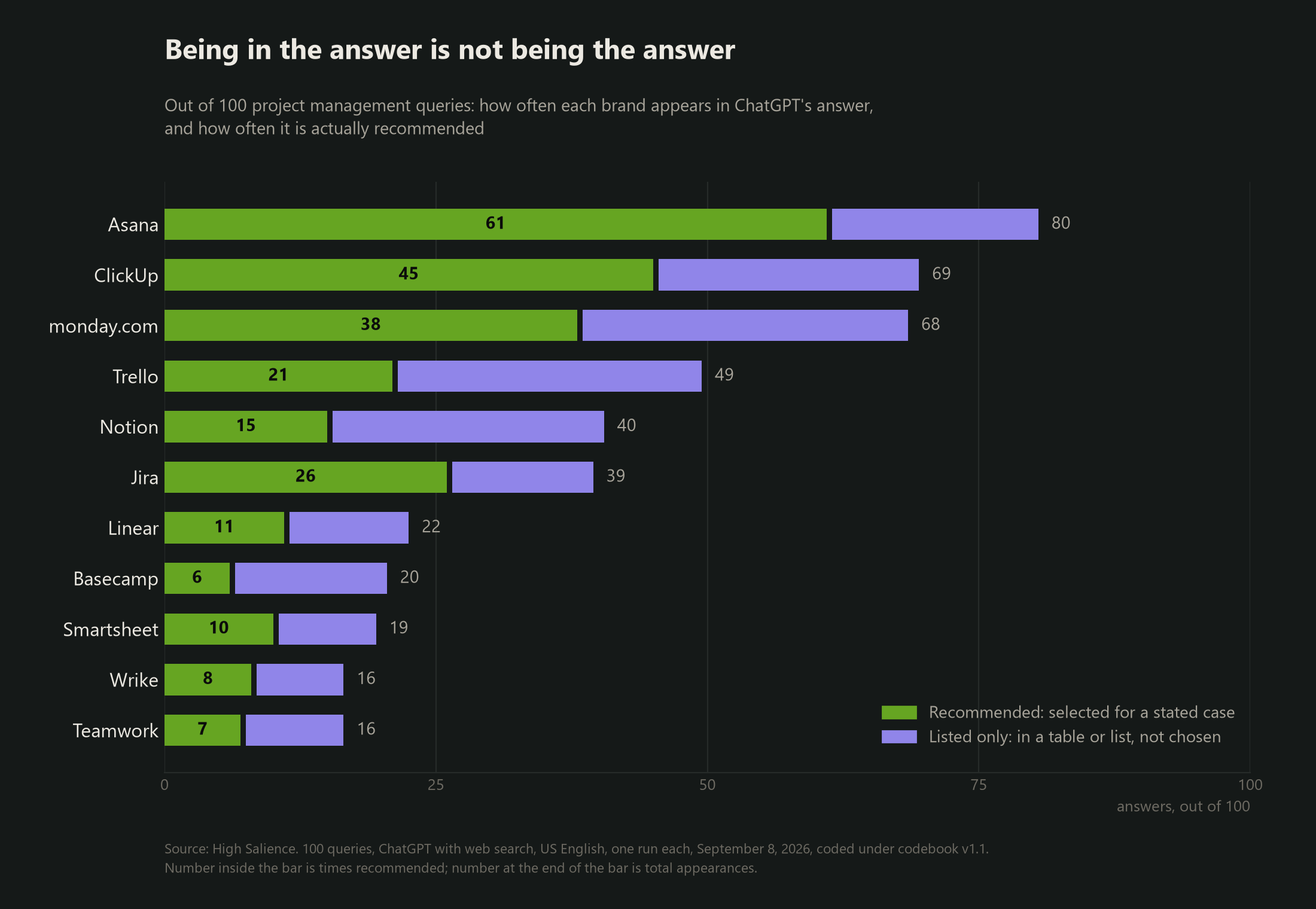
| Brand | Appears in | Recommended in | Recommended share of appearances |
|---|---|---|---|
| Asana | 80 | 61 | 76% |
| ClickUp | 69 | 45 | 65% |
| monday.com | 68 | 38 | 56% |
| Trello | 49 | 21 | 43% |
| Notion | 40 | 15 | 38% |
| Jira | 39 | 26 | 67% |
| Linear | 22 | 11 | 50% |
| Basecamp | 20 | 6 | 30% |
| Smartsheet | 19 | 10 | 53% |
| Wrike | 16 | 8 | 50% |
| Teamwork | 16 | 7 | 44% |
Out of 100 answers. "Recommended" means the answer selected the brand for a stated case. "Appears" adds brands that were listed in a table or bullet list without being chosen.
Mentions are furniture
Notion is in 40 answers and chosen in 15. Basecamp is in 20 and chosen in 6. Trello is in half the answers and chosen in a fifth. Any tool that reports "mentions" would show these three as doing fine. The model puts them in the comparison table to look thorough and then tells the buyer to use Asana or ClickUp. If your AI visibility report counts appearances, it is counting furniture.
A "vs" query is a fork, not a fight
In 28 of 30 head-to-head queries, ChatGPT recommended every brand named in the query. The reply has one shape: pick A if you need this, pick B if you need that. One query produced a single winner, Smartsheet over Microsoft Project. One produced no pick at all. The model is not choosing between you and your competitor on a comparison query. It is choosing the conditions under which each of you wins, then handing the buyer the conditions. Whoever wrote the clearest version of "use us when" owns their side of the fork.
When the buyer says "recommend", the model commits
Eighteen of twenty recommendation-intent queries produced a clear pick among the general-market brands we coded. Asana was chosen in 11 of the 20, ClickUp in 8, monday.com in 4, Jira in 4, Trello in 3, Teamwork in 3. Teamwork is recommended in only 7 answers overall, but 3 of those are recommendation queries about agencies and client work: a narrow frame can win the queries that match it while being invisible everywhere else.
The other two queries abandoned the competitive set entirely. Ask about a construction company and the model recommends Procore, Buildertrend and Fieldwire. Ask about a law firm and it recommends Clio. None of the eleven brands in the table appear. One word in the prompt swapped the entire field.
Ranking in Google is a different game
Of the 266 recommended brand mentions, 208 were for brands whose own website does not rank in Google's top ten organic results for that query. That's 78 percent. Not because those brands are weak in search, but because Google's top ten for these queries is 75 percent listicles, review sites and comparison pages: only 254 of the 1,000 organic results we pulled were brand sites at all. The page that ranks first for "best project management software" is usually Forbes or Zapier. The brand ChatGPT recommends is Asana.
The model cites the vendors, and mostly one vendor
Across 100 answers there were 362 citation events to 114 domains, counted as one per cited domain per answer. Sixty percent went to vendors' own sites, and half of all answers cited nothing but vendor pages. The most-cited domain is clickup.com at 52 citations. Asana, the most-recommended brand, was cited 46 times. ClickUp earned its citations with its own comparison pages and "best tools" guides, which the model reads and quotes even when it then recommends someone else. The most-cited third-party domain is G2 with 12. Reddit and Wikipedia have zero citations in this sample.
Only 83 of the 362 citation events involved a domain that also sat in Google's top ten organic results for that query. Twenty-three percent. The other seventy-seven percent of the evidence behind the recommendation lives outside the results a rank tracker shows you.
03Cross-check
Two vendor tools, same day, as a check.
We read Ahrefs Brand Radar and Semrush AI Visibility for the same brands on the same day. Their numbers are their own, built from their own prompt corpora, and are not comparable to ours. Direction is comparable.
Ahrefs' topic table for project management software puts Asana first at 913 responses out of 1,062, then Trello at 868, ClickUp at 813, Jira at 742 and monday.com at 600. Semrush's domain view, which counts every prompt naming the brand, has Trello at 75.4K mentions to Asana's 70.6K, but Trello at 5.3K citations to Asana's 90.3K.
Three things line up: Asana is first everywhere; Trello is mentioned constantly, chosen rarely and barely cited; ClickUp's pages get cited well beyond how often the brand gets picked. One thing does not: Reddit is a top cited source in both vendor corpora and appears zero times in our live run. Same category, different sampling method, different answer. That is exactly why a single dashboard number cannot be trusted without its method attached.
04What this changes
Four things, in order.
Count recommendations, not mentions. Mentions are furniture.
On comparison queries, write the fork. State plainly when you are the right choice and when you are not. The model is going to say it anyway. Better it says it in your words.
Find the vertical prompts that swap the field, and decide whether you want to be in those fields.
Stop using Google rankings as a proxy for AI recommendation. In this sample the overlap was weak enough that the two need to be measured separately.
05Limitations
What this teardown cannot tell you.
One run per query means answer variance is unmeasured; Benchmark 01 runs each query three times across three surfaces. The brand dictionary was built for the general project management market and deliberately does not score vertical tools. Sentiment coding was rule-based and is not reported because the rules were too generous to trust. The ChatGPT scraper dropped six queries on first pass and all six were recovered on retry inside the same window. Google's control counts a brand as ranking only when its own domain is in the top ten; a listicle that features the brand does not count.
06Dataset
Check it, don't believe it.
Every number above can be recomputed from these files. CC BY 4.0: use them, cite the page.
- queries.csv: the 100 queries with intent labels.
- brands.csv: the 48-brand dictionary with aliases and canonical domains.
- mentions.csv: 511 coded brand mentions with position, type and whether the brand's domain was in Google's top ten.
- citations.csv: 362 citation events with domain class and Google overlap.
- observations.csv: one row per query with brand, recommendation, citation and control counts.
- codebook.md: the rulebook, with dated amendments.
This teardown was also published on the High Salience Substack and AISEO Course Review.
Update, September 17, 2026: the same method was run on CRM software as Teardown 02 and on email marketing as Teardown 03. Their hand-checks produced codebook amendments v1.4 and v1.5 (hedged selecting verbs, conditional assignments such as "small team: Trello", link addresses excluded from matching, the brand being replaced in an "alternatives" query coded as an anchor). The figures on this page are the original v1.1 coding. Under v1.5 the recommendation counts rise for every brand because the rulebook now catches the "case: brand" lines it used to code as listed: Asana 61 to 68, ClickUp 45 to 55, monday.com 38 to 47, Trello 21 to 32, Notion 15 to 27, Jira 26 to 31. The ordering does not change. This dataset recoded under v1.5 is published with the later teardowns, and the codebook linked above carries every amendment.
This took one afternoon and a few dollars in API calls.
It is the same thing we do inside a Category Salience Brief, on your category, against your competitors, with the query set you approve first.