HIGH SALIENCE / RESEARCH / PAYMENT PROCESSING TEARDOWN
TEARDOWN 06 · PUBLISHED SEPTEMBER 17, 2026 · DATASET INCLUDED
100 Payment Processing Questions: Stripe Is the Default, and the Rest Get Priced, Not Picked
A category outside the benchmark's 20, same method: 100 payment processing queries, ChatGPT with web search on, every answer coded under the rulebook the earlier teardowns used, Google's top ten as a control. Project management had a favorite, CRM a big four, email marketing a seven-way spread. Payment processing has a default, Stripe, and a model that answers most other questions the way a broker would: it asks for your monthly volume and average ticket, quotes each processor's published rate, and offers to run the math.
01Method
Same query structure, same coding, one new category.
Queries: 100 payment processing queries built from the same templates as the earlier teardowns: 30 category, 30 comparison, 20 alternative and 20 recommendation. The full list is in the dataset.
Surface: ChatGPT with web search forced on, logged out, United States, English, via the DataForSEO scraper, one run per query, collected September 17, 2026.
Control: Google's top ten organic results for the same queries in the same window, via the DataForSEO SERP API at depth 20 and truncated to the first ten organic results.
Coding: every brand named was coded as recommended (selected for a stated case), listed (in a table or list without being chosen), passing, or anchor (the brand being replaced in an "alternatives" query), against a 62-brand dictionary fixed before collection, under codebook v1.5. Cited URLs were deduplicated to their domain and classed as first-party or third-party. Five answers drawn with a fixed seed were hand-checked: 22 coded mentions, of which one is an anchor row excluded by rule. Nineteen of the remaining 21 agreed with the reader, 90 percent, at the floor the codebook sets. The two misses are PayPal and Venmo named inside the condition of a bolded lead-in ("Customers heavily use PayPal/Venmo: Braintree") and coded listed where a reader would say passing; they are left in and reported. One Stripe mention was coded negative where the answer reads as neutral; sentiment is not used in any figure on this page.
Collection note: the ChatGPT answers were collected through the DataForSEO connector's live ChatGPT scraper rather than the standard queue, one query at a time between 16:10 and 16:57 UTC on September 17, same surface and settings; 14 queries needed a second or later attempt after dropped connections and all 100 completed. The Google control was collected through the standard queue in the same hour. Two answers ("stripe or paypal for an online store" and "what payment processor should I use to invoice clients") came back priced for Portugal in euros despite the United States setting; they are coded as returned and noted in Limitations.
Coder note: the rulebook is unchanged, but the coder that applies it was corrected in three places for this dataset, and the corrections are documented in coder-notes.md: the check for whether a brand is named in the query is case-insensitive (queries are lowercase, and Square, Stripe, Clover, Toast and fourteen other names match answer text only when capitalized, so without the fix "stripe vs square" was never recognized as naming either brand); the v1.5 conditional-assignment pattern accepts a bold marker directly before the brand name; and two written cues are matched with an adverb or a word-order change ("I'd also look at", "the first one I'd investigate"). The earlier teardowns' figures were not recomputed by this session.
One run per query, so this is a teardown, not the benchmark. Frequencies describe this window only. Absence means not observed in this sample, never zero visibility.
02Findings
One default, then a rate card.
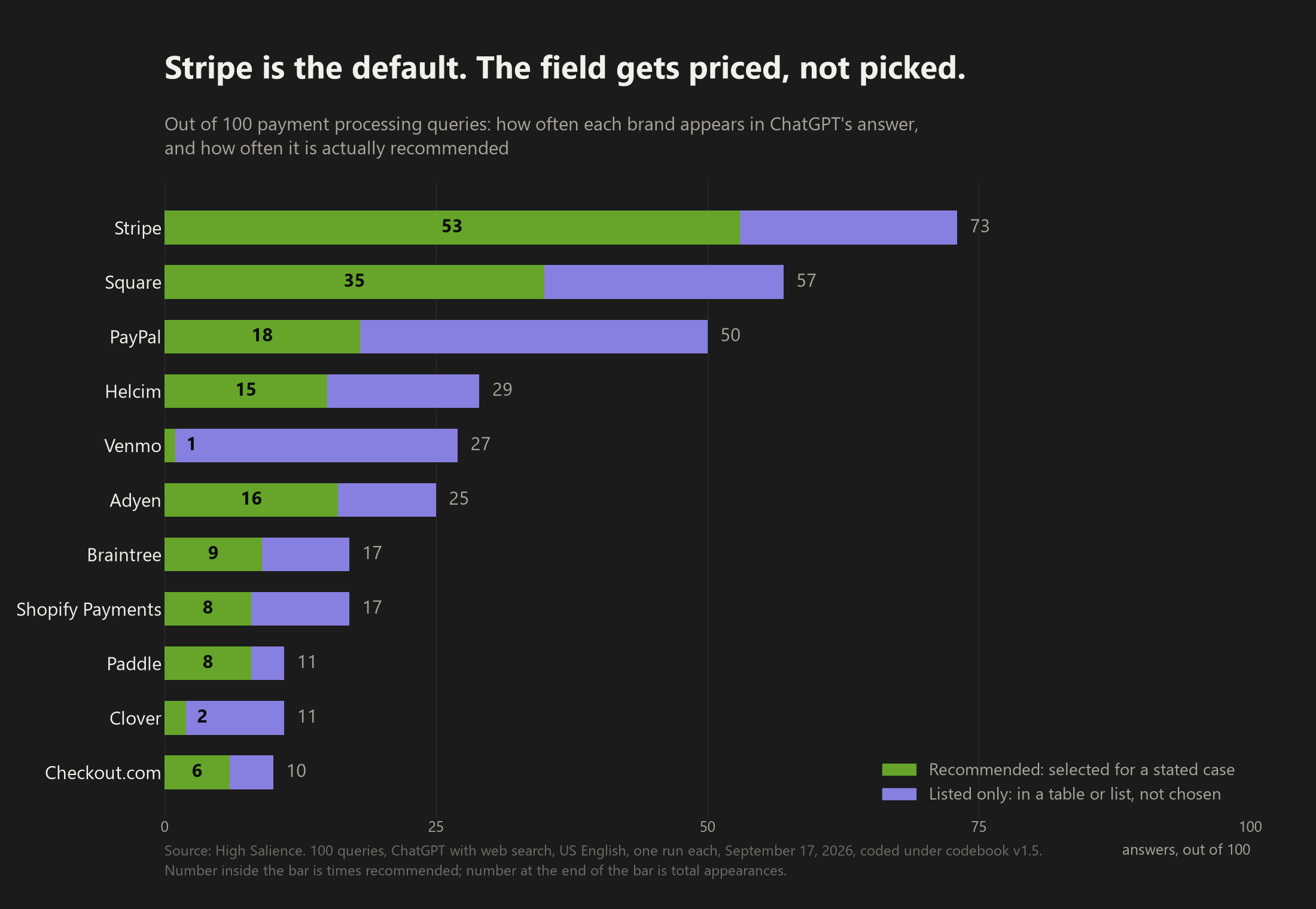
| Brand | Appears in | Recommended in | Recommended share of appearances |
|---|---|---|---|
| Stripe | 73 | 53 | 73% |
| Square | 57 | 35 | 61% |
| PayPal | 50 | 18 | 36% |
| Helcim | 29 | 15 | 52% |
| Venmo | 27 | 1 | 4% |
| Adyen | 25 | 16 | 64% |
| Braintree | 17 | 9 | 53% |
| Shopify Payments | 17 | 8 | 47% |
| Paddle | 11 | 8 | 73% |
| Clover | 11 | 2 | 18% |
| Checkout.com | 10 | 6 | 60% |
Out of 100 answers, codebook v1.5. "Recommended" means the answer selected the brand for a stated case. "Appears" adds brands listed in a table or bullet list without being chosen. The brand being replaced in an "alternatives" query is excluded from both columns.
Stripe is the default, and it is the only one
Stripe appears in 73 of 100 answers and is recommended in 53, a recommendation share of 73 percent of its appearances. Square is next at 57 appearances and 35 recommendations, then PayPal at 50 and 18. PayPal is the most-named brand the model least often chooses: it is usually described as "an additional checkout option" or the wallet customers expect, not the processor. Behind the three sit Helcim (29 appears, 15 chosen), Adyen (25, 16), Braintree (17, 9), Shopify Payments (17, 8) and Paddle (11, 8). Venmo is named in 27 answers and recommended in one; Apple Pay in seven and recommended in none. They are in the dictionary because they were listed before collection, and they show how much of the model's payment vocabulary is wallets rather than processors.
When the buyer asks outright, the default holds. Eighteen of 20 recommendation-intent queries produced a dictionary pick, and Stripe was the pick on 15 of the 20, Square on 6, PayPal on 5, Paddle on 3, Adyen, Shopify Payments and QuickBooks Payments on 2 each. The two answers with no dictionary pick are the 50-person company, where the answer reads "Stripe if you're primarily an online company, Square if you have a physical location" in a form the rulebook does not catch, and the law firm, which left the set entirely (below).
Eighty-eight answers ask for your numbers
This is the mechanism the earlier categories did not have. Eighty-eight of 100 answers ask the buyer for their own figures, typically monthly card volume, average transaction size and the split between online and in-person, and 78 of those also offer to calculate the monthly cost of two or three processors side by side. Sixty-three answers quote at least one published rate in the form "2.9% + $0.30", and 57 cite a vendor's own pricing or fees page. Recommendations per category answer average 2.3, and 33 of 100 answers recommend three or more brands, but the recommendation is usually conditional on numbers the buyer has not given yet. The model is not choosing a processor. It is quoting the rate card and holding the decision until it has the inputs.
Head-to-heads: 21 forks, and Stripe wins the ones that are not
Twenty-one of 30 comparison queries recommended every brand named in the query. Seven picked one side: Stripe on four of them (against PayPal, against Adyen, against Adyen and Checkout.com together, and "Stripe or PayPal for an online store"), Square over Clover, Adyen over Checkout.com, and SumUp over Square. Two picked nobody ("payment depot vs helcim" and "helcim vs stax vs payment depot" both end with a request for the buyer's volume). All 16 of Stripe's comparison recommendations are on queries that name Stripe; like Mailchimp in email marketing, it is chosen as a side of the fork, never imported into somebody else's comparison.
The lane is stable, and it is stated in the model's words
Every brand behind Stripe gets one repeatable sentence. Square is "in-person, POS, the free plan": it is the pick for farmers markets, retail and the front desk of a medical practice. Helcim is "interchange-plus as volume grows" in 29 of the 30 answers that name it, which is how a company with far less coverage than PayPal ends up recommended nearly as often. Paddle and Lemon Squeezy are "merchant of record for software that does not want a tax team". Adyen and Checkout.com are "enterprise, global, high volume". Toast is restaurants. The lane is the reason a brand is named at all, and in a category where the model defers the final choice to a cost calculation, owning the sentence that puts you in the calculation is the position that matters.
Vertical prompts re-rank the field, and two of them replace it
Most vertical prompts keep the general brands and reorder them: restaurants get Toast, Square, Clover and Lightspeed; medical practices get Square first and Chase Payment Solutions with InstaMed for EHR integration; nonprofits get Stripe and PayPal; real estate gets QuickBooks Payments, Square and Stripe. Two prompts swapped the field out. Both law firm queries recommended LawPay and Clio Payments, neither in the dictionary, "rather than generic processors like Stripe or Square", on trust-account grounds. The high-risk query recommended Durango Merchant Services alone. The open-source query recommended Kill Bill, Lago and Hyperswitch and said plainly that a self-hosted Stripe does not exist. Fourteen answers in total recommended no dictionary brand: two left the set as above, six contain a pick a reader sees and the rulebook does not ("the first one I'd compare with PayPal", "I'd start here" under a Shopify Payments heading, "Stripe if you're primarily online"), and six are tables or hedges that genuinely choose nobody.
Ranking in Google is a different game, and Adyen is the proof
Of the 210 recommended brand mentions, 160 were for brands whose own website does not rank in Google's top ten organic results for that query, 76 percent. Google's top ten for these queries is 79 percent third-party pages (787 of 1,000 results). Adyen is recommended 16 times and its site is in the top ten for none of those queries. PayPal is recommended 18 times and ranks for one. Stripe is recommended 53 times and ranks for 19.
Vendors are the sources, and NerdWallet is the referee
Across 100 answers there were 301 citation events to 98 domains, one per cited domain per answer. Fifty-three percent (161) went to vendors' own sites, and 47 answers cited nothing but vendor pages; only project management (60 percent, 50 answers) leaned harder on vendors. The most-cited domains are stripe.com (42), squareup.com (28), nerdwallet.com (25), paypal.com (18), adyen.com (15) and helcim.com (13). NerdWallet is the only third-party site cited more than nine times; TechnologyAdvice (9), Fit Small Business (6) and myPayAdvisor (6) follow. The ten most-cited domains cover 58 percent of citation events. Ninety-eight of the 301 citation events (33 percent) involved a domain that also sat in Google's top ten for that query. Reddit and Wikipedia have zero citations in this sample, for the sixth teardown running.
036 categories, side by side
Same rulebook, every category so far.
| Measure (codebook v1.5) | Project management, Sept 8 | CRM, Sept 17 | Email marketing, Sept 17 | Help desk, Sept 17 | Accounting, Sept 17 | Payment processing, Sept 17 |
|---|---|---|---|---|---|---|
| Recommendations per category answer (average) | 4.8 | 3.3 | 3.3 | 3.9 | 3.1 | 2.3 |
| Answers with no recommended dictionary brand | 5 of 100 | 13 of 100 | 7 of 100 | 8 of 100 | 9 of 100 | 14 of 100 |
| Most-recommended brand: appears / recommended | Asana 76 / 68 | HubSpot 77 / 62 | Mailchimp 61 / 40 | Zendesk 74 / 54 | QuickBooks 75 / 58 | Stripe 73 / 53 |
| Head-to-head queries recommending every named brand | 29 of 30 | 26 of 30 | 30 of 30 | 28 of 30 | 27 of 30 | 21 of 30 |
| Recommendation-intent queries with a dictionary pick | 18 of 20 | 16 of 20 | 17 of 20 | 18 of 20 | 19 of 20 | 18 of 20 |
| Recommended mentions where the brand does not rank in Google's top 10 | 305 of 368 (83%) | 187 of 287 (65%) | 216 of 309 (70%) | 255 of 336 (76%) | 136 of 268 (51%) | 160 of 210 (76%) |
| Google top 10 that is third-party pages | 746 of 1,000 (75%) | 710 of 1,000 (71%) | 720 of 1,000 (72%) | 714 of 1,000 (71%) | 743 of 1,000 (74%) | 787 of 1,000 (79%) |
| Citation events to vendors' own sites | 216 of 362 (60%) | 136 of 320 (42%) | 193 of 367 (53%) | 152 of 345 (44%) | 125 of 302 (41%) | 161 of 301 (53%) |
| Answers citing only vendor pages | 50 of 100 | 40 of 100 | 37 of 100 | 27 of 100 | 34 of 100 | 47 of 100 |
| Share of citations in the 10 most-cited domains | 54% | 40% | 42% | 45% | 55% | 58% |
| Citation events whose domain is in Google's top 10 | 83 of 362 (23%) | 83 of 320 (26%) | 97 of 367 (26%) | 80 of 345 (23%) | 99 of 302 (33%) | 98 of 301 (33%) |
| Reddit and Wikipedia citations | 0 | 0 | 0 | 0 | 0 | 0 |
All columns are coded under codebook v1.5; the project management column is the September 8 dataset recoded under it. Each teardown is one run per query in its own window, so differences between columns mix category with collection date.
04What this changes
Four things, in order.
Publish the rate card where the model can read it. Fifty-seven answers cite a vendor pricing or fees page, and the model quotes the number it finds there. A processor whose pricing sits behind a quote form is priced from a third party's guess or left out of the calculation. Interchange-plus vendors should publish the markup, not "custom pricing".
Own one sentence, in the model's words. Stripe is the default. For everyone else the position is the lane: the conditions under which the model names you. Helcim's sentence is "interchange-plus as volume grows" and it earns 15 recommendations on 29 appearances. Write yours so that it survives being paraphrased.
Write the fork, and the four cases where it is not one. Twenty-one of 30 head-to-heads recommended both sides. The seven that did not went to the brand whose use case was stated more plainly, and Stripe took four of them. A comparison page that says when the other processor is the better choice is the format the model already uses.
Measure the overlap with Google per category. Seventy-six percent of recommendations here go to brands not ranking for the query; Adyen is recommended 16 times and ranks for none. Across the earlier five categories it ran from 50 percent in accounting to 83 in project management, with email marketing at 70 and CRM at 65. It is a property of the category, not of AI search.
05Limitations
What this teardown cannot tell you.
One run per query means answer variance is unmeasured; Benchmark 01 runs each query three times across three surfaces. The teardowns are collected on different days, so differences between categories mix the category with the date. The brand dictionary covers the general payment processing market and deliberately excludes vertical tools, so their appearances are described in prose and not counted. The rule-based coder has one known failure: a brand named as a contrast on the same line as a selecting verb is coded as recommended. Sentiment coding is rule-based and not reported. No vendor-tool cross-check was read for this category. Google's control counts a brand as ranking only when its own domain is in the top ten; a listicle that features the brand does not count. Two answers were returned for a Portugal market in euros despite the United States setting and are coded as returned; their picks are in the data. The brand dictionary was written before collection and includes wallets, buy-now-pay-later and billing platforms (Venmo, Apple Pay, Google Pay, Klarna, Affirm, Chargebee, Recurly, Bolt) that are named in answers and, apart from one Venmo mention, never recommended as processors; they do not affect the figures above. LawPay, Clio Payments, MyCase Payments, Kill Bill, Lago, Hyperswitch, TouchBistro, SpotOn, InstaMed and Mangopay were not in it and are described in prose only. On the "best payment processing for law firms" query, Stripe and Square are coded recommended because "I'd shortlist LawPay and Clio Payments rather than generic processors like Stripe or Square" carries a selecting verb on the same line; that is the contrast-mention failure mode documented in the CRM teardown, and it is left in.
06Dataset
Check it, don't believe it.
Every number above can be recomputed from these files. CC BY 4.0: use them, cite the page.
- queries.csv: the 100 queries with intent labels.
- brands.csv: the 62-brand dictionary with aliases and canonical domains.
- mentions.csv: 450 coded brand mentions with position, type and whether the brand's domain was in Google's top ten.
- citations.csv: 301 citation events with domain class and Google overlap.
- observations.csv: one row per query with brand, recommendation, citation and control counts.
- coder-notes.md: how the answers were collected and the three coder corrections applied for this dataset
- codebook.md: the rulebook, with dated amendments through v1.5.
The earlier teardowns: Teardown 01, project management, Teardown 02, crm, Teardown 03, email marketing, Teardown 04, help desk, Teardown 05, accounting. This teardown is also being published on the High Salience Substack.
Six categories, and a new mechanism.
A favorite, a big four, a seven-way spread, and now a category where the model quotes the rate card and waits for your numbers. Which one you are fighting decides what you build, and the only way to know is to measure your own category. A Category Salience Brief runs this exact method on it, with a query set you approve first.