HIGH SALIENCE / RESEARCH / PAYROLL TEARDOWN
TEARDOWN 07 · PUBLISHED SEPTEMBER 21, 2026 · DATASET INCLUDED
100 Questions, Seventh Category: Payroll, Where One Brand's Website Is Cited in Two Answers Out of Three
Seventh category, same method: 100 payroll software queries, ChatGPT with web search on, every answer coded under the rulebook the earlier teardowns used, Google's top ten as a control. Payroll has the most cautious answers of any category so far, and inside that caution one brand wins every time the model does commit. The reason is visible in the citations: one vendor's website is the model's main reading material for the whole category.
01Method
Same query structure, same coding, one new category.
Queries: 100 payroll software queries built from the same templates as the earlier teardowns: 30 category, 30 comparison, 20 alternative and 20 recommendation. The full list is in the dataset.
Surface: ChatGPT with web search forced on, logged out, United States, English, via the DataForSEO scraper, one run per query, collected September 21, 2026.
Control: Google's top ten organic results for the same queries in the same window, via the DataForSEO SERP API at depth 20 and truncated to the first ten organic results.
Coding: every brand named was coded as recommended (selected for a stated case), listed (in a table or list without being chosen), passing, or anchor (the brand being replaced in an "alternatives" query), against a 55-brand dictionary fixed before collection, under codebook v1.5. Cited URLs were deduplicated to their domain and classed as first-party or third-party. Five answers drawn with a fixed seed were hand-checked: 20 coded mentions, 19 agreed with the reader. The one disagreement was Gusto described as "particularly compelling for a small business" without a selecting verb, which the rulebook codes as listed; it is left in and reported.
Collection note: the ChatGPT answers and the Google controls for this category were both collected through the DataForSEO connector's live endpoints, one query at a time, with the same settings as the earlier teardowns. The Google controls were pulled two result pages deep, because a single page at depth 20 returned fewer than ten organic results for most payroll queries; every control has ten. Eleven aliases in the brand dictionary were narrowed before coding because they are also ordinary words or name a parent product ("remote", "check", "hourly", "plane", "warp", and the payroll add-ons of Sage, Xero, Wave, Square and Toast); the dictionary shipped with the dataset is the narrowed one.
One run per query, so this is a teardown, not the benchmark. Frequencies describe this window only. Absence means not observed in this sample, never zero visibility.
02Findings
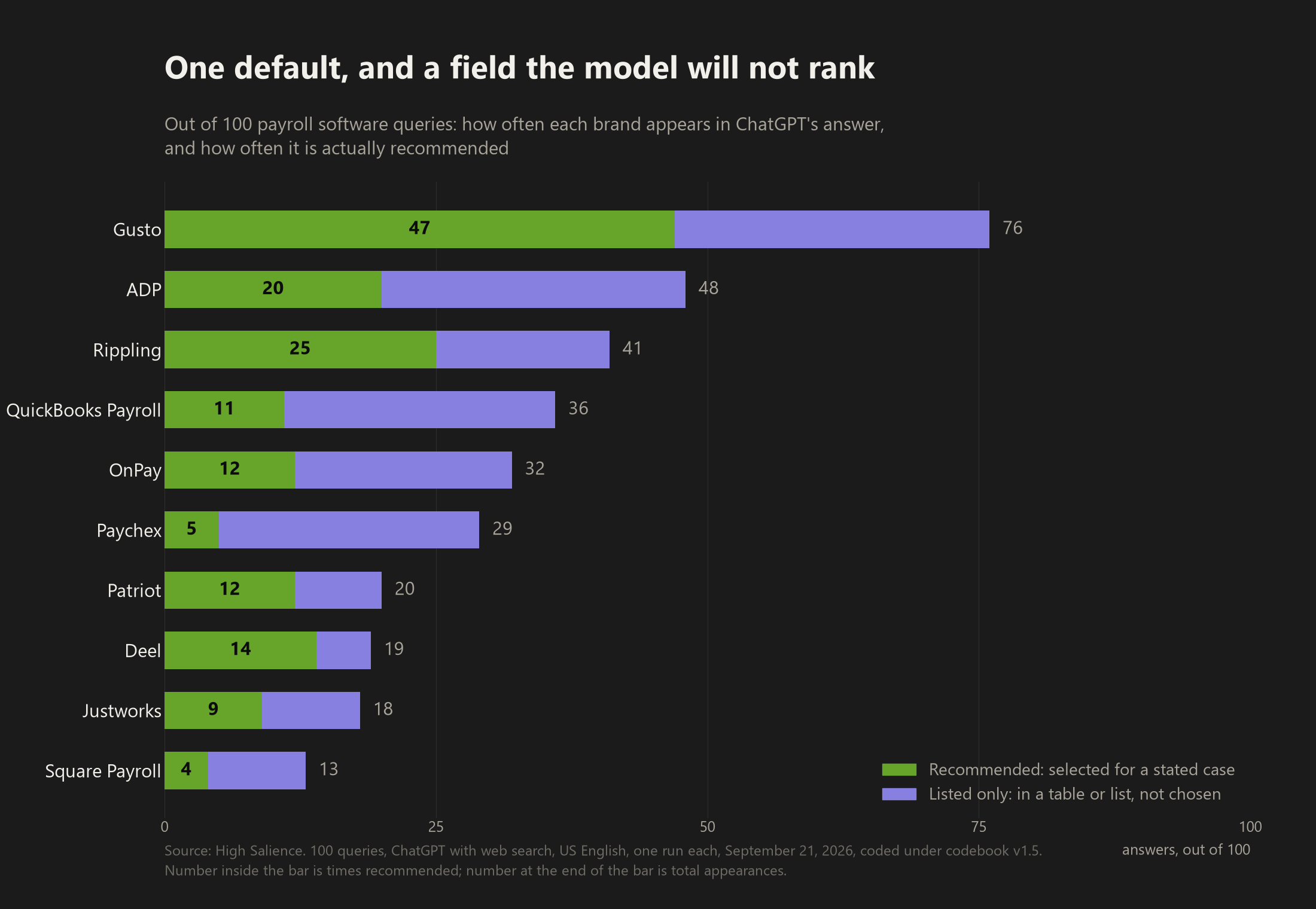
One default, and a field the model will not rank.
| Brand | Appears in | Recommended in | Recommended share of appearances |
|---|---|---|---|
| Gusto | 76 | 47 | 62% |
| ADP | 48 | 20 | 42% |
| Rippling | 41 | 25 | 61% |
| QuickBooks Payroll | 36 | 11 | 31% |
| OnPay | 32 | 12 | 38% |
| Paychex | 29 | 5 | 17% |
| Patriot | 20 | 12 | 60% |
| Deel | 19 | 14 | 74% |
| Justworks | 18 | 9 | 50% |
| Square Payroll | 13 | 4 | 31% |
Out of 100 answers, codebook v1.5. "Recommended" means the answer selected the brand for a stated case. "Appears" adds brands listed in a table or bullet list without being chosen. The brand being replaced in an "alternatives" query is excluded from both columns.
Gusto is in every pick
Gusto is named in 76 of 100 answers and recommended in 47. Fourteen of the 20 recommendation-intent queries produced a pick from the dictionary, and Gusto was among the picks in all 14. It was the only pick for a solo business owner, a law firm and an accountant managing multiple client companies. Rippling was picked in 6, ADP and Deel in 4 each, Justworks in 3. No other category in this series has a brand present in every recommendation answer that committed.
The rest of the field is named and passed over
Below Gusto the recommendation rate falls off harder than in any earlier category. ADP is named in 48 answers and chosen in 20. QuickBooks Payroll is named in 36 and chosen in 11. OnPay 32 and 12. Paychex is named in 29 answers and chosen in 5, and three of those five are the queries that explicitly ask about a 50-person or multi-state company. The brands that do get chosen when named are narrow specialists: Deel is named in 19 and chosen in 14, almost always for international or contractor payroll, and Patriot is named in 20 and chosen in 12, almost always as the cheapest full-service option.
The model asks for your headcount before it answers
Ninety of the 100 answers end by asking the buyer for more context, and 77 ask specifically for the number of employees. Twenty-eight answers recommended no dictionary brand at all, twice the next-highest category (payment processing at 14, CRM at 13), spread across every intent. The comparison queries show it most clearly. Eighteen of 30 head-to-heads recommended both sides, the fewest of the seven categories; seven recommended neither. Gusto versus ADP, Gusto versus Paychex, ADP versus Paychex and Deel versus Remote each came back as a feature table followed by a request for headcount, states and benefits. Two of the seven noted that Paychex acquired Paycor in 2025 and treated the comparison as largely moot.
The vertical prompts mostly kept the general field
Law firms and nonprofits got Gusto, OnPay, Justworks and ADP. A real estate brokerage got Gusto and Square Payroll. Restaurants got Toast Payroll and Homebase alongside Gusto and ADP. Healthcare practices got Paylocity. Two prompts did swap the field: household employers were sent to Poppins Payroll, SurePayroll Household and HomePay by Care.com, and construction companies to Payroll4Construction, Foundation Software and Miter, with Gusto and QuickBooks Payroll kept for small private-work contractors only.
More than half the recommendations go to brands that rank
Of the 191 recommended brand mentions, 87 were for brands whose own website does not rank in Google's top ten organic results for that query, 46 percent. That is the lowest figure of the seven categories. Google's top ten for payroll queries is also the most vendor-heavy so far: 347 of the 1,000 organic results are brand sites, and gusto.com, adp.com, intuit.com and onpay.com hold their own category pages.
One website is the reading list
Across 100 answers there were 314 citation events to 91 domains, one per cited domain per answer. gusto.com alone accounts for 65 of them, 21 percent of every citation in the category, and it is cited in 65 of the 100 answers. Forty-eight of those 65 answers are to questions that do not mention Gusto at all: "best payroll software for restaurants", "ADP alternatives", "which payroll software should I use for a 50 person company". Gusto publishes comparison and guide pages on its competitors, and the model reads them. The next most-cited domains are adp.com (20), patriotsoftware.com (15) and intuit.com (13). Sixty-one percent of all citation events went to vendors' own sites, the highest share of any category, and 49 answers cited nothing but vendor pages. Fit Small Business (12) and G2 (10) lead a thin third-party half. Reddit and Wikipedia have zero citations, for the seventh teardown running.
One hundred thirty-four of the 314 citation events involved a domain that also sat in Google's top ten for that query, 43 percent, the highest overlap so far.
037 categories, side by side
Same rulebook, every category so far.
| Measure (codebook v1.5) | Project management, Sept 8 | CRM, Sept 17 | Email marketing, Sept 17 | Help desk, Sept 17 | Accounting, Sept 17 | Payment processing, Sept 17 | Payroll, Sept 21 |
|---|---|---|---|---|---|---|---|
| Recommendations per category answer (average) | 4.8 | 3.3 | 3.3 | 3.9 | 3.1 | 2.3 | 2.0 |
| Answers with no recommended dictionary brand | 5 of 100 | 13 of 100 | 7 of 100 | 8 of 100 | 9 of 100 | 14 of 100 | 28 of 100 |
| Most-recommended brand: appears / recommended | Asana 76 / 68 | HubSpot 77 / 62 | Mailchimp 61 / 40 | Zendesk 74 / 54 | QuickBooks 75 / 58 | Stripe 73 / 53 | Gusto 76 / 47 |
| Head-to-head queries recommending every named brand | 29 of 30 | 26 of 30 | 30 of 30 | 28 of 30 | 27 of 30 | 21 of 30 | 18 of 30 |
| Recommendation-intent queries with a dictionary pick | 18 of 20 | 16 of 20 | 17 of 20 | 18 of 20 | 19 of 20 | 18 of 20 | 14 of 20 |
| Recommended mentions where the brand does not rank in Google's top 10 | 305 of 368 (83%) | 187 of 287 (65%) | 216 of 309 (70%) | 255 of 336 (76%) | 136 of 268 (51%) | 160 of 210 (76%) | 87 of 191 (46%) |
| Google top 10 that is third-party pages | 746 of 1,000 (75%) | 710 of 1,000 (71%) | 720 of 1,000 (72%) | 714 of 1,000 (71%) | 743 of 1,000 (74%) | 787 of 1,000 (79%) | 653 of 1,000 (65%) |
| Citation events to vendors' own sites | 216 of 362 (60%) | 136 of 320 (42%) | 193 of 367 (53%) | 152 of 345 (44%) | 125 of 302 (41%) | 161 of 301 (53%) | 192 of 314 (61%) |
| Answers citing only vendor pages | 50 of 100 | 40 of 100 | 37 of 100 | 27 of 100 | 34 of 100 | 47 of 100 | 49 of 100 |
| Share of citations in the 10 most-cited domains | 54% | 40% | 42% | 45% | 55% | 58% | 55% |
| Citation events whose domain is in Google's top 10 | 83 of 362 (23%) | 83 of 320 (26%) | 97 of 367 (26%) | 80 of 345 (23%) | 99 of 302 (33%) | 98 of 301 (33%) | 134 of 314 (43%) |
| Reddit and Wikipedia citations | 0 | 0 | 0 | 0 | 0 | 0 | 0 |
All columns are coded under codebook v1.5; the project management column is the September 8 dataset recoded under it. Each teardown is one run per query in its own window, so differences between columns mix category with collection date.
04What this changes
Four things, in order.
Your competitor's content can be your competitor's recommendation engine. In this category the model reads gusto.com to answer questions about ADP, Paychex and restaurant payroll. A vendor that publishes the category's best comparison pages is writing the model's briefing notes. If that vendor is not you, you are being described in someone else's words.
Answer the headcount question on the page. The model asks for employee count in 77 answers because the pages it reads do not say who each product is for by size. The brand that states "for 1 to 50 employees in one state" in plain words gives the model a condition it can use.
Being big is not being chosen. Paychex is one of the largest payroll companies in the country and is chosen in 5 of the 29 answers that name it. Scale gets you into the table; a stated case gets you out of it.
Specialists win their lane outright. Deel for international, Patriot for cheapest, Toast for restaurants, Poppins for household employers. A narrow, clearly stated case is chosen at three to four times the rate of a broad one.
05Limitations
What this teardown cannot tell you.
One run per query means answer variance is unmeasured; Benchmark 01 runs each query three times across three surfaces. The teardowns are collected on different days, so differences between categories mix the category with the date. The brand dictionary covers the general payroll software market and deliberately excludes vertical tools, so their appearances are described in prose and not counted. The rule-based coder has one known failure: a brand named as a contrast on the same line as a selecting verb is coded as recommended. Sentiment coding is rule-based and not reported. No vendor-tool cross-check was read for this category. Google's control counts a brand as ranking only when its own domain is in the top ten; a listicle that features the brand does not count. The ChatGPT answers and Google controls for this category were collected four days after the earlier teardowns, through the live connector rather than the standard queue; the settings are the same, the window is not. The dictionary excludes vertical tools by design; Payroll4Construction, Miter, Restaurant365 and HR for Health are described in prose only.
06Dataset
Check it, don't believe it.
Every number above can be recomputed from these files. CC BY 4.0: use them, cite the page.
- queries.csv: the 100 queries with intent labels.
- brands.csv: the 55-brand dictionary with aliases and canonical domains.
- mentions.csv: 427 coded brand mentions with position, type and whether the brand's domain was in Google's top ten.
- citations.csv: 314 citation events with domain class and Google overlap.
- observations.csv: one row per query with brand, recommendation, citation and control counts.
- codebook.md: the rulebook, with dated amendments through v1.5.
The earlier teardowns: Teardown 01, project management, Teardown 02, crm, Teardown 03, email marketing, Teardown 04, help desk, Teardown 05, accounting, Teardown 06, payment processing. This teardown is also being published on the High Salience Substack.
Seven categories, and the reading list is the story.
In payroll the model's picks track one vendor's website. In help desk they track a comparison blog nobody had heard of. In accounting they track NerdWallet. Finding out what the model is reading for your category is the first thing a Category Salience Brief does, with a query set you approve first.