HIGH SALIENCE / RESEARCH / WHERE CHATGPT GETS ITS INFORMATION
RESEARCH NOTE · PUBLISHED · DATASET INCLUDED
Where Does ChatGPT Get Its Information? Mostly Not Google's or Bing's Page One
ChatGPT gets most of its information from pages that are not on Google's or Bing's page one, judging by 200 answers we collected on October 21, 2026. We asked ChatGPT 100 everyday questions, twice each, and compared the pages it pulled up with Google's and Bing's first page for the exact searches ChatGPT ran. In the 33 answers we could check against both engines, 78% of the pages it pulled up were on neither first page. The sites it went on to cite were as established as Google's page one: 14% came from small sites, against 13% on Google. ChatGPT reads widely, and it still leans on established sites when it decides what to cite.
BY BIKE HAWLEY, FOUNDER
01The Finding
Where ChatGPT's search results come from
ChatGPT's search results come from outside Google's and Bing's first page far more often than from inside it. For the 33 answers whose searches we could check against a Google results page read in a browser, this is where each page ChatGPT pulled up or cited stood on the same day:
| ChatGPT pages | Total | Google page one only | Both page ones | Bing page one only | Neither page one |
|---|---|---|---|---|---|
| Pages ChatGPT pulled up | 399 | 24 (6%) | 29 (7%) | 36 (9%) | 310 (78%) |
| Pages ChatGPT cited | 221 | 16 (7%) | 13 (6%) | 17 (8%) | 175 (79%) |
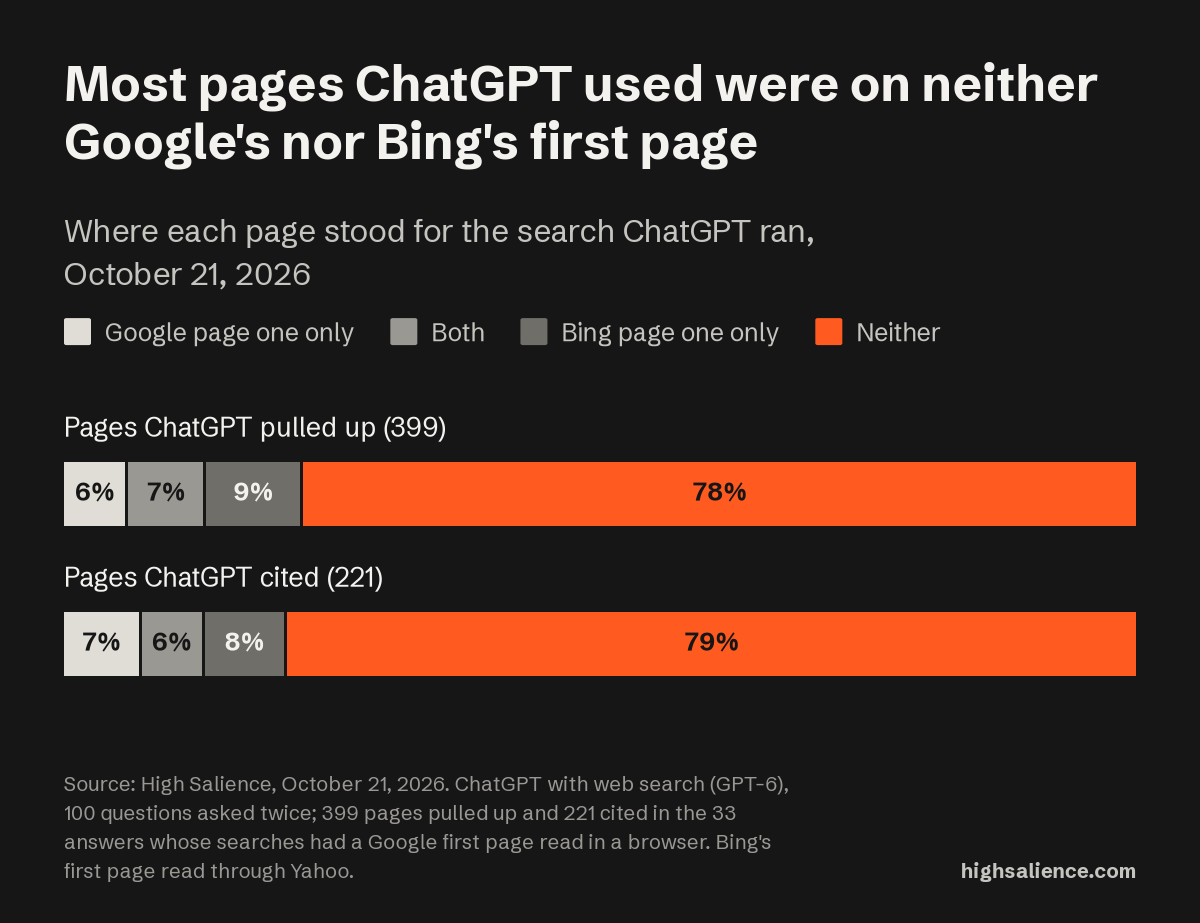
13% of the pages ChatGPT pulled up were on Google's page one and 16% on Bing's. Counting sites instead of pages changes little: 56% of the sites it pulled up had no page on either first page. Across all 198 answers we could check against Bing, Bing's page one held 13% of the 2,811 pages ChatGPT pulled up and 17% of the 1,315 it cited.
ChatGPT did not lean on either engine's top picks. It pulled up 24% of Google's top three results and 20% of Bing's. The two engines were different yardsticks too: their first pages shared 22% of their pages for these searches.
The pattern fits what Peec AI found in ChatGPT's own data from May to July 2026: an index of OpenAI's own, called Labrador, used next to Google results bought from scraping services and Microsoft's Web IQ (Peec AI on ChatGPT's own index).
02One Search
ChatGPT vs Google vs Bing for one search
For one search, ChatGPT vs Google vs Bing looks like this. Asked for the best project management software for small teams, ChatGPT searched for "best project management software for small teams 2026 Asana ClickUp Trello Monday Linear pricing features" and pulled up the sites in the last column. Three of the small software review sites it used, smashingapps.com, techstackdaily.com and ctbzai.com, were on Bing's first page and nowhere on Google's.
| # | Google page one | Bing page one | What ChatGPT pulled up |
|---|---|---|---|
| 1 | ones.com | softwarefinder.com | aversusb.net |
| 2 | rock.so | smashingapps.com | dupple.com |
| 3 | reddit.com | project-management.com | smashingapps.com (on Bing) |
| 4 | onplana.com | clickup.com | techstackdaily.com (on Bing) |
| 5 | tech-insider.org | spunk.work | entrepreneurbytes.com |
| 6 | probackup.io | cloudwards.net | pickrtech.com |
| 7 | forbes.com | getpricepulse.com | digitallab247.com |
| 8 | till-freitag.com | techstackdaily.com | pmcompared.com |
| 9 | waveup.com | ctbzai.com | ctbzai.com (on Bing) |
| 10 | productsverdict.com | techrepublic.com | |
| 11 | softwaresift.com |
This search is the clearest case for Bing in the sample. Most searches look less like either engine.
03Citations
How ChatGPT chooses which sources to cite
ChatGPT chooses which sources to cite from a rougher pool than the one it shows. We scored every site with DataForSEO's domain rank, a link-based score from 0 to 1,000, and counted the share of results that came from small sites, those ranked under 200:
| Results | Results counted | From small sites | Median domain rank |
|---|---|---|---|
| Google page one | 327 | 13% | 468 |
| Pages ChatGPT cited | 221 | 14% | 497 |
| Bing page one | 480 | 25% | 392 |
| Pages ChatGPT pulled up | 399 | 26% | 473 |
Small sites made up 26% of the pages ChatGPT pulled up, about the same as Bing's page one (25%). They made up 14% of the pages it cited, about the same as Google's page one (13%). Between searching and citing, small sites lost about half their share, and the sites ChatGPT cited were as established as the ones Google ranks.
04Bing Traces
Bing tracking tags in ChatGPT's results
Bing tracking tags turned up in ChatGPT's results, and Google's never did. Search engines add a tag to some result links: Bing adds msockid and Google adds srsltid. This is how often each tag appeared:
| Tracking tag | Added by | Share of the engine's own result links | Links in ChatGPT's results carrying it |
|---|---|---|---|
| msockid | Bing | 148 of 4,671 (3%) | 23 of 3,022 pulled up and 8 cited, in 11 of 200 answers |
| srsltid | 126 of 6,488 (2%) | none of 3,022 pulled up |
Some of the Bing tags came back identical in separate answers that used different search wording, which points to copies stored in OpenAI's own index rather than fresh Bing lookups.
Shops showed up through a third route: 13 cited product links in 9 answers came from merchant product feeds sent to OpenAI, tagged utm_campaign=openai_catalog, from shops such as bedstory.com, casper.com and echohifi.com.
05News
Where ChatGPT gets news sources
For news, ChatGPT gets its sources from a short list of wire services and large publishers. Reuters was cited in 19 of the 30 news answers and AP in 5. Only 5% of the 585 news pages ChatGPT pulled up were on Bing's first page for the same search. For a brand, coverage that the wires pick up is a more direct route into these answers than ranking, and our guide to digital PR covers how that coverage is earned.
06Scraped Results
Why Google results are harder to collect
Google results are harder to collect than they were a month ago, which is the backdrop to this study. Since mid-September, rank tracking firms have reported Google serving automated traffic normal-looking result pages with the usual sites swapped out (Nozzle's measurements). Our own data feeds showed the same on October 21:
- Our paid Google feed matched the real Google page in 23 of 120 pulls. The swapped pages leaned on smaller sites: 28% small sites and a median domain rank of 383, against 13% and 468 on the real page.
- The direct Bing feed returned results for only the first word of the search on 40% of 468 pulls, such as dictionary pages for "best".
- Yahoo, whose web results come from Bing, stayed clean (5 bad pulls out of 498), so this study reads Bing's index through Yahoo.
Few of ChatGPT's pages trace back to the swapped versions: 2% of the sites it pulled up appeared only on a swapped Google page and on no real first page.
07What It Means
What ChatGPT's sources mean for SEO
ChatGPT's sources mean SEO for AI answers has to reach past Google's first page.
- Page one covers a minority of citations. About one in five of the pages ChatGPT cited were on Google's or Bing's first page for its own searches (21% of 221). The rest came from elsewhere, most likely its own index.
- Established sites keep their place. Small sites were pulled up often and cited about half as often. The signals behind getting cited by ChatGPT still separate the sources it uses from the ones it passes over.
- Match the searches ChatGPT runs. Its searches averaged 11 words and stacked the year, brand names and comparison terms, such as "best travel rewards credit cards 2026 annual fee welcome bonus benefits comparison". Pages that answer that whole question in one place match what it looks for.
- Measure ChatGPT on its own. Google rankings are a weak stand-in for ChatGPT visibility. Our guide to measuring AI visibility explains how to track each surface separately, and planning for both is the core of AI SEO done properly.
08Method
How the ChatGPT source study was run
We ran the ChatGPT source study on October 21, 2026.
ChatGPT: 100 everyday questions in six groups (best-of picks, facts, how-tos, news, local and shopping), each asked twice, so 200 answers: web search on, logged out, United States, English, collected through the DataForSEO ChatGPT scraper. The model reported itself as GPT-6. For each answer we kept the searches ChatGPT ran, the pages it pulled up and the pages it cited.
Searches: 249 different searches, about 1.3 per answer, each used word for word.
Google: first pages (the top ten organic results) read in a desktop browser, United States, English, for 40 of the searches, covering 33 answers. Three DataForSEO pulls of every search were checked against those pages.
Bing: Bing's index read through Yahoo's results, two DataForSEO pulls per search, combined. Yahoo's pages matched the Bing pages we read in a browser closely but not exactly.
Site strength: DataForSEO domain rank (0 to 1,000) for all 4,490 sites in the study. Small sites are those under 200.
Matching: a page counts as on a first page when its address matches once tracking tags are removed. Pages on google.com itself are left out on both sides.
Limits: one day, one country, two runs per question and the top ten results only, so a page ChatGPT used may still rank further down. The Google comparison covers 33 answers, mostly best-of, fact and how-to questions; news, local and shopping are compared with Bing only. ChatGPT's answers vary between runs, so treat these as frequencies for this sample.
Sources we drew on:
- Peec AI, ChatGPT search result providers (September 2026)
- cloro, swapped Google results and how often each data provider got them (October 20, 2026)
- Search Engine Journal on a study of how far Google results explain ChatGPT's citations (October 18, 2026)
09Data
Download the ChatGPT source dataset
You can download the ChatGPT source dataset to check every figure on this page. One file has a row for each page ChatGPT pulled up or cited, with whether it was on Google's and Bing's first page and its site's domain rank; the other has a row for each search ChatGPT ran, with the sites on each engine's first page.
- chatgpt-pages.csv (3,221 rows, CC BY 4.0)
- chatgpt-searches.csv (249 rows, CC BY 4.0)
Earlier notes found the same split from other angles: AI answers in four industries and YouTube in AI Overviews vs ChatGPT.
10Next Step
See where ChatGPT gets its information in your category
To see where ChatGPT gets its information in your category, and which of your pages it pulls up or passes over, start with a Category Salience Brief. It maps the sources behind the AI answers your buyers see, with competitors side by side.