HIGH SALIENCE / RESEARCH / YOUTUBE IN AI ANSWERS
RESEARCH NOTE · PUBLISHED · UPDATED · DATASET INCLUDED
Google's AI Overviews Cite YouTube Most, and ChatGPT Never Did
We looked at which sites Google's AI Overviews and ChatGPT cited for the same 700 commercial software questions, and how YouTube compared with the others. YouTube was the most-linked site in Google's AI Overviews: 524 of 2,395 source links (22%), in 221 of the 647 Overviews shown. ChatGPT's answers to the same questions cited YouTube zero times. The two systems are reading different parts of the web, and a source strategy built for one can miss the other.
BY BIKE HAWLEY, FOUNDER
01The Finding
How often AI Overviews and ChatGPT cite YouTube
Given the same questions, Google's AI Overviews cited YouTube more often than any other site and ChatGPT never cited it: the two worked from different reading lists, and YouTube was on only one of them.
| Category | Questions | AI Overviews shown | Overviews linking YouTube | YouTube share of Overview source links | YouTube in Google top 10 | ChatGPT answers citing YouTube |
|---|---|---|---|---|---|---|
| Project management | 100 | 100 | 53 (53%) | 154 of 545 (28%) | 41 (41%) | 0 |
| CRM | 100 | 94 | 32 (34%) | 83 of 351 (24%) | 44 (44%) | 0 |
| Email marketing | 100 | 90 | 25 (28%) | 67 of 279 (24%) | 38 (38%) | 0 |
| Help desk | 100 | 82 | 8 (10%) | 12 of 187 (6%) | 27 (27%) | 0 |
| Accounting | 100 | 95 | 40 (42%) | 95 of 413 (23%) | 48 (48%) | 0 |
| Payment processing | 100 | 95 | 29 (31%) | 48 of 284 (17%) | 50 (50%) | 0 |
| Payroll | 100 | 91 | 34 (37%) | 65 of 336 (19%) | 61 (61%) | 0 |
| Total | 700 | 647 | 221 (34%) | 524 of 2395 (22%) | 309 (44%) | 0 |
YouTube led every other domain in the Overviews' source lists by a wide margin: the next most-linked site, reddit.com, had 127 links. Video results were also common in Google's classic results, with a YouTube page in the organic top ten for 309 of the 700 questions.
02Source Mix
Where AI Overviews and ChatGPT get their sources
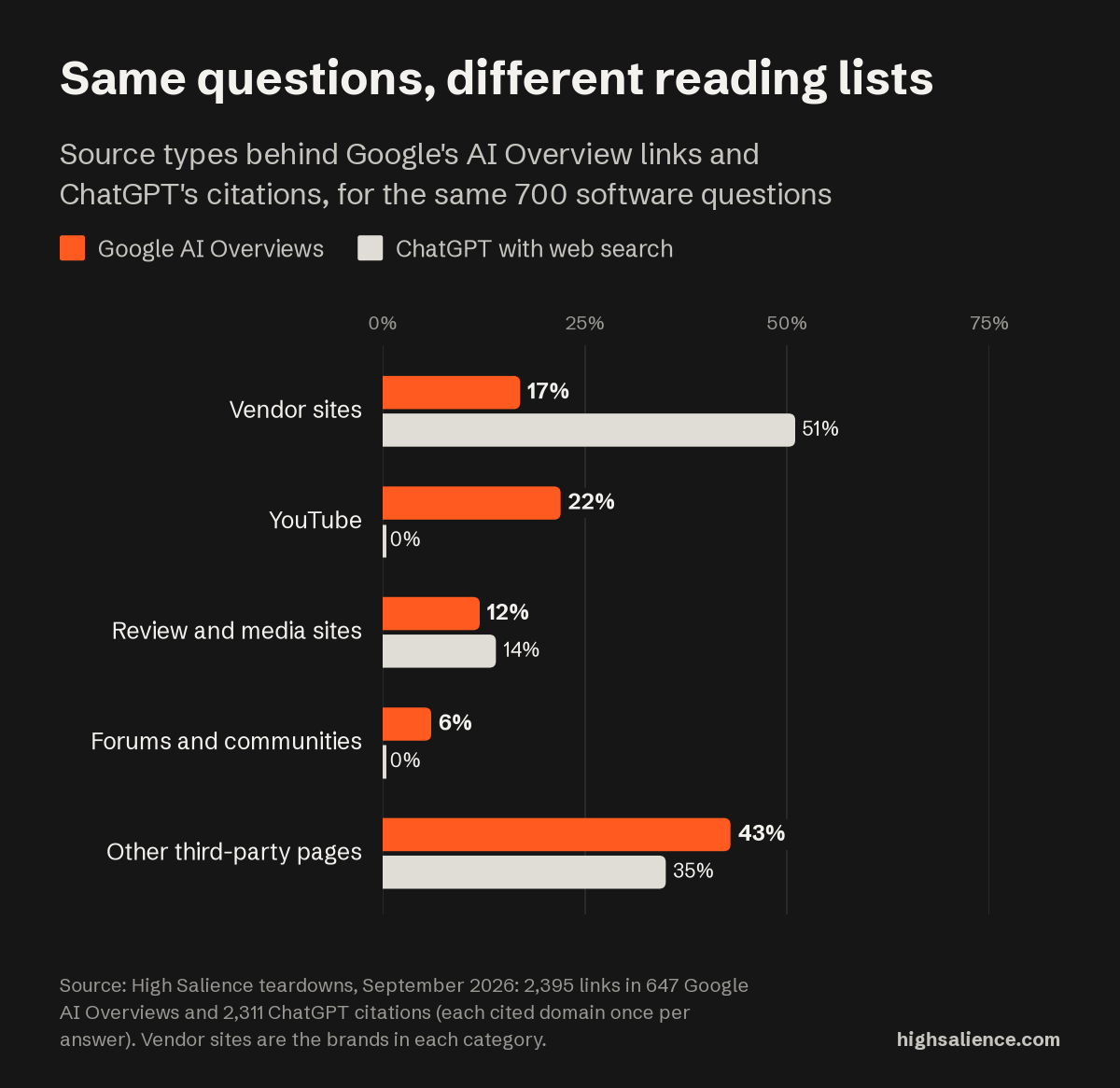
Google's AI Overviews and ChatGPT each get their sources from a different mix of sites.
| Source type | Google AI Overviews (share of source links) | ChatGPT (share of citations) |
|---|---|---|
| Vendor sites (the brands in the category) | 17% | 51% |
| YouTube | 22% | 0% |
| Review and media sites | 12% | 14% |
| Forums and communities (Reddit, Quora and similar) | 6% | 0% |
| Other third-party pages | 43% | 35% |
| Total | 2,395 links | 2,311 citations |
The contrast is not only YouTube. ChatGPT leaned hard on the vendors' own websites, which supplied about half of its citations. Google's AI Overviews drew most of their links from third parties: video, review sites, forums and a long tail of blogs and comparison pages. Our earlier note found the same split for Reddit: in Google's results for 631 of these questions and never in ChatGPT's live answers (Reddit vs ChatGPT).
03Method
How the YouTube data was collected
We collected the YouTube data from Google and ChatGPT on the same days.
Questions: the 700 queries from our seven published teardowns, 100 per category, split across category, comparison, alternative and recommendation phrasing. The full list is in the dataset.
Google: desktop results, United States, English, collected through the DataForSEO SERP API. We counted the unique source links listed with each AI Overview and the first ten organic results. Collection dates: project management on September 8, 2026; five categories on September 17; payroll between September 17 and 21.
ChatGPT: web search on, logged out, United States, English, one run per question, collected via the DataForSEO ChatGPT scraper on the same days. Citations are the sources each answer linked, as coded for the teardowns.
Source types: vendor sites are the domains of the brands in each category's dictionary; review and media sites and forums follow the lists in the teardown codebook; everything else is "other third-party".
Limits: one run per question, one country, commercial software questions only, and desktop Overviews only. Answers vary between runs, so treat these as frequencies for this sample. Zero here means not observed in 700 answers, not that ChatGPT can never cite YouTube. DataForSEO's aggregated ChatGPT mention data for these categories points the same way: across the 20 categories we pulled, youtube.com never appeared as a cited source.
04What It Means
What the YouTube finding means for your AI search strategy
For your AI search strategy, the YouTube finding means planning for two systems that cite different sources.
- Video is a Google AI surface. If buyers in your category see AI Overviews, and on these questions they saw one 647 times out of 700, the videos that explain and compare products are part of what the Overview is built from.
- Your own site matters more for ChatGPT. About half of ChatGPT's citations went to vendor sites, against about one in six of the Overviews' links. Clear product, pricing and comparison pages feed ChatGPT directly.
- Measure each surface separately. One "AI visibility" number that blends Google and ChatGPT hides the fact that they cite different sources. Our guide to measuring AI visibility explains how to split it.
- Plan sources, not just pages. Deciding which sources to earn a place in, video, review sites or your own pages, is the core of AI SEO done properly.
05Data
Check the 700-question YouTube dataset
You can check the figures in the per-question YouTube dataset, which has one row for each of the 700 questions: the query, whether an AI Overview appeared, how many source links it listed and how many were YouTube, whether YouTube ranked in Google's top ten and its best position, and how many citations the ChatGPT answer had and how many were YouTube.
- youtube-presence.csv (700 rows, CC BY 4.0)
The underlying ChatGPT citation datasets are published on each teardown page.
06Next Step
See whether YouTube feeds the AI answers in your category
Every category draws on a different mix of sources, so it is worth seeing whether YouTube feeds the AI answers in yours, and which other sources do. The Category Salience Brief maps them across Google and the AI surfaces, with competitors side by side.