HIGH SALIENCE / RESEARCH / HR SOFTWARE TEARDOWN
TEARDOWN 08 · PUBLISHED SEPTEMBER 26, 2026 · UPDATED SEPTEMBER 27, 2026 · DATASET INCLUDED
100 Questions, Eighth Category: HR Software, Where Three Brands Share the Top and One Comparison Page Keeps Getting Cited
Eighth category, same method: 100 HR software queries, ChatGPT with web search on, every answer coded under the rulebook the earlier teardowns used, Google's top ten as a control. HR has no single default: three brands split the top almost evenly, the biggest enterprise suites are recommended far more often than they are picked, and one comparison page covering exactly the three leaders is cited in 13 answers without ranking for any of the questions.
This page was recoded on September 27, 2026 under codebook v2.0: two independent AI readers coded every answer and a third reader settled their disagreements. The rule-based coder behind the original figures agreed with them on 61.4 percent of brand codes. The biggest changes: answers recommending no dictionary brand fell from 23 to 6 (17 answers make no pick), Rippling rather than Gusto now has the most recommendations (57, up from 38, with 50 picks), and head-to-heads recommending every named brand rose from 19 to 28 of 30 (21 at the picked level). The earlier version's data is available on request.
01Method
Same query structure, same coding, one new category.
Queries: 100 HR software queries built from the same templates as the earlier teardowns: 30 category, 30 comparison, 20 alternative and 20 recommendation. The full list is in the dataset.
Surface: ChatGPT with web search forced on, logged out, United States, English, via the DataForSEO scraper, one run per query, collected September 26, 2026.
Control: Google's top ten organic results for the same queries in the same window, via the DataForSEO SERP API at depth 20 and truncated to the first ten organic results.
Coding: every answer was coded by two independent AI readers (Claude agents working blind from a written protocol), with a third settling disagreements. They were not people. Each brand named was coded picked (the answer's own verdict: "my pick", "choose X if", a shortlist it tells you to act on, the #1 of its ranking), recommended (assigned to a stated case or fit, such as "best for small teams", without being the answer's verdict), listed (named as an option, no fit given), passing (named but not offered as an option) or anchor (the brand being replaced in an "alternatives" query), against a 52-brand dictionary fixed before coding (see the collection note), under codebook v2.0. "Recommended" in the tables includes picked brands. The two readers agreed on 97.4% of brand codes in this teardown (99.6% at the recommended level). Cited URLs were deduplicated to their domain and classed as first-party or third-party.
Collection note: the ChatGPT answers and the Google controls were collected on September 26, 2026 through the DataForSEO standard queue, the same route as the second through sixth teardowns, with raw responses saved exactly as returned. Before coding, the brand dictionary was corrected in three places so one mention could not count twice or match an ordinary word: the separate Zenefits row was folded into TriNet, which owns it; the bare alias "zoho" was removed from Zoho People because it also matched Zoho Payroll; and Remote's alias was narrowed to "remote.com" so the ordinary word "remote" is not read as the brand. Both dictionaries and the list of changes ship with the dataset.
One run per query, so this is a teardown, not the benchmark. Frequencies describe this window only. Absence means not observed in this sample, never zero visibility.
02Findings
No default, a lot of caution, and a reading list you can name.
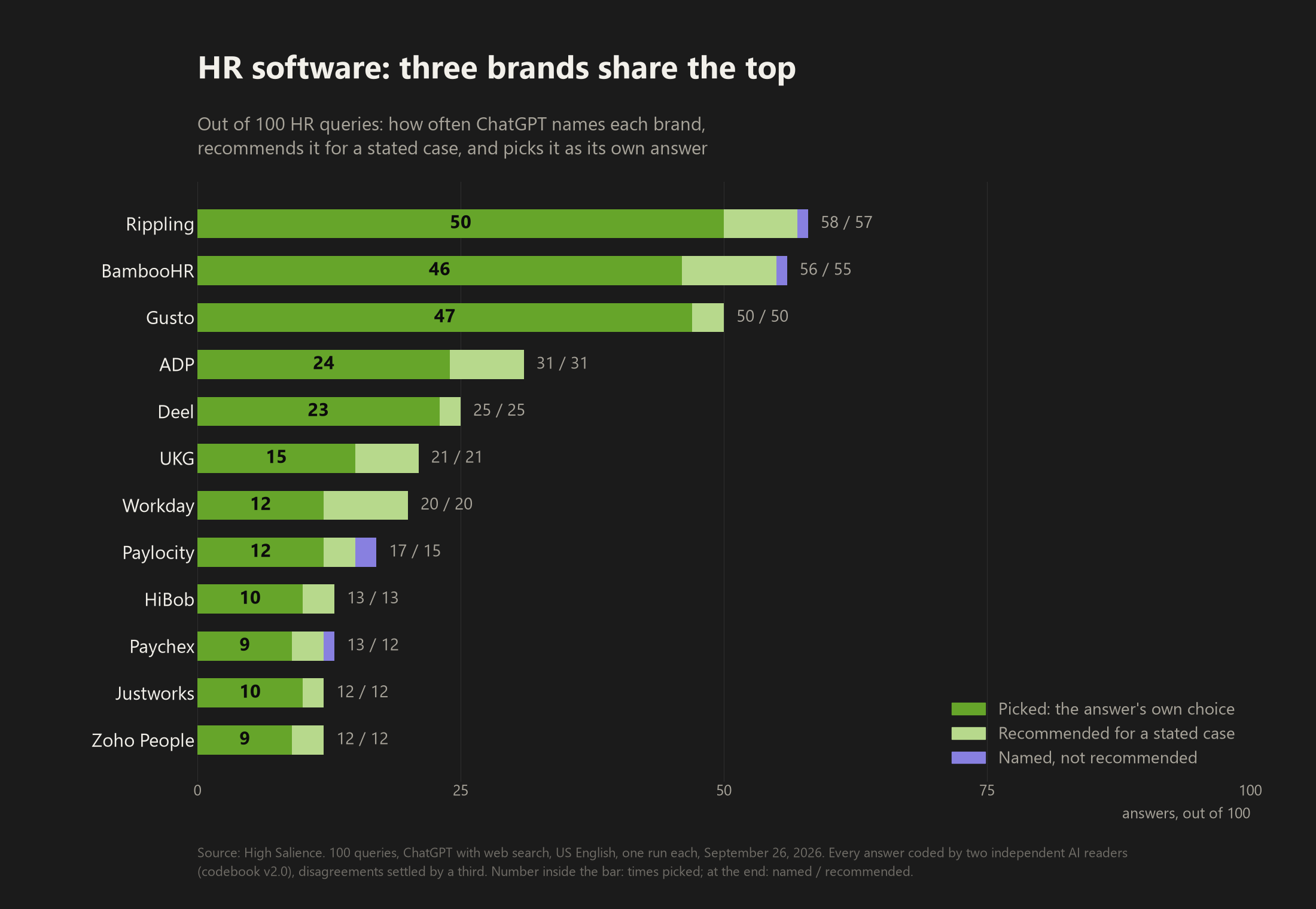
| Brand | Appears in | Recommended in | Picked in | Picked share of appearances |
|---|---|---|---|---|
| Rippling | 58 | 57 | 50 | 86% |
| BambooHR | 56 | 55 | 46 | 82% |
| Gusto | 50 | 50 | 47 | 94% |
| ADP | 31 | 31 | 24 | 77% |
| Deel | 25 | 25 | 23 | 92% |
| UKG | 21 | 21 | 15 | 71% |
| Workday | 20 | 20 | 12 | 60% |
| Paylocity | 17 | 15 | 12 | 71% |
| HiBob | 13 | 13 | 10 | 77% |
| Paychex | 13 | 12 | 9 | 69% |
| Justworks | 12 | 12 | 10 | 83% |
| Zoho People | 12 | 12 | 9 | 75% |
Each linked brand has its own page: how ChatGPT recommends every brand in this dataset, with positioning labels, head-to-head results and sources.
Out of 100 answers, codebook v2.0. "Picked" means the answer itself chose the brand as its verdict, overall or for a case. "Recommended" means the answer assigned the brand to a stated case or fit, and includes picked brands. "Appears" adds brands named as an option with no fit. The brand being replaced in an "alternatives" query is excluded from all columns.
Three brands share the top
Rippling is named in 58 answers, recommended in 57 and picked in 50. BambooHR is named in 56, recommended in 55 and picked in 46. Gusto is named in 50, recommended in all 50 and picked in 47, the highest pick rate of any brand named in at least ten answers. Email marketing also had no single default, but its leaders were spread wider; here the three are within eight appearances and four picks of each other. On the 20 direct advice questions, 18 produced a pick from the dictionary: Gusto was picked in 16, Rippling and BambooHR in 14 each, and all three were picked together in 13. For a marketing agency and a growing startup, the picks were exactly those three names.
The big enterprise suites are recommended and seldom picked
SAP SuccessFactors and Dayforce are each named in 9 answers and picked in 3; Oracle HCM is named in 8 and picked in 2. Enterprise questions get catalogs rather than verdicts: "best enterprise HR software" recommended six suites and picked none, and Workday versus SAP SuccessFactors, Workday versus Oracle HCM and UKG versus ADP all came back without a pick. Workday does better, picked in 12 of its 20 appearances, including the questions about the best HCM platform for large companies and Workday or UKG for a large company. ADP, UKG, Paylocity and Paychex are picked more often than not: ADP in 24 of its 31 appearances, UKG 15 of 21, Paylocity 12 of 17, Paychex 9 of 13. The specialists win their lanes: Deel is picked in 23 of its 25 appearances, including the international and fully remote questions; Homebase for restaurants and hourly workers; Lattice, Culture Amp and 15Five for performance management; and Frappe HR in both questions that ask for open source.
A cautious category, even in head-to-heads
Seventeen answers make no pick of their own, behind only payment processing (22) and payroll (19). Six recommended no dictionary brand, the most of the eight categories. Three of those six named none at all: two stopped after a sentence or two, and one read "agencies" as recruiting agencies and answered with recruiting software outside the HR dictionary. Most answers ask the buyer for more detail, usually employee count or company size. Twenty-eight of the 30 head-to-heads recommended every brand named for some case, but only 21 picked every brand named, and eight picked none: BambooHR versus Workday, Workday versus SAP SuccessFactors, Workday versus Oracle HCM, Paycom versus Paylocity, UKG versus ADP, Namely versus BambooHR, Paylocity versus Paycor versus Paycom, and BambooHR or Rippling for a small business all came back without a verdict. The Freshteam versus BambooHR answer noted that Freshteam appears to be a legacy product and pointed new buyers to BambooHR, the one head-to-head that picked only one side.
Three quarters of the recommendations go to brands that do not rank
Of the 405 recommended brand mentions, 310 were for brands whose own website does not rank in Google's top ten organic results for that query, 77 percent. Of the 311 picked mentions, 232 were, 75 percent. Google's top ten for these queries is 82 percent third-party pages: 820 of the 1,000 organic results.
One comparison page, cited 13 times
Across 100 answers there were 325 citation events to 121 domains. Vendors' own sites took 167 of them, 51 percent, led by bamboohr.com and gusto.com with 29 each and rippling.com with 19. As in payroll, the vendors' pages are read well beyond their own name: gusto.com is cited in 29 answers, and 24 of those questions never mention Gusto. The most-cited third parties are technologyadvice.com (17) and witho2.com (13). Every one of the witho2.com citations is the same page, a comparison of Rippling, Gusto and BambooHR, and it ranked in Google's top ten for none of the 13 questions it was cited on. It compares exactly the three brands that lead this teardown. That is a correlation in one sample, not proof of cause, but it is the clearest example yet of a single page sitting behind a category's answers. Reddit and Wikipedia have zero citations, for the eighth teardown running.
Eighty-five of the 325 citation events involved a domain that also sat in Google's top ten for that query, 26 percent.
038 categories, side by side
Same rulebook, every category so far.
| Measure (codebook v2.0) | Project management, Sept 8 | CRM, Sept 17 | Email marketing, Sept 17 | Help desk, Sept 17 | Accounting, Sept 17 | Payment processing, Sept 17 | Payroll, Sept 21 | HR software, Sept 26 |
|---|---|---|---|---|---|---|---|---|
| Recommendations per category answer (average) | 5.9 | 4.3 | 5.0 | 5.5 | 4.3 | 4.2 | 4.6 | 5.0 |
| Answers with no recommended dictionary brand | 1 of 100 | 5 of 100 | 1 of 100 | 1 of 100 | 0 of 100 | 5 of 100 | 1 of 100 | 6 of 100 |
| Answers with no pick (the answer's own verdict) | 2 of 100 | 11 of 100 | 2 of 100 | 4 of 100 | 9 of 100 | 22 of 100 | 19 of 100 | 17 of 100 |
| Most-recommended brand: appears / recommended | Asana 73 / 73 | HubSpot 75 / 74 | Mailchimp 58 / 56 | Zendesk 70 / 69 | QuickBooks 75 / 73 | Stripe 70 / 68 | Gusto 73 / 73 | Rippling 58 / 57 |
| Most-picked brand: appears / picked | Asana 73 / 70 | HubSpot 75 / 69 | Mailchimp 58 / 44 | Zendesk 70 / 61 | QuickBooks 75 / 65 | Stripe 70 / 54 | Gusto 73 / 61 | Rippling 58 / 50 |
| Head-to-head queries recommending every named brand | 30 of 30 | 28 of 30 | 30 of 30 | 29 of 30 | 26 of 30 | 28 of 30 | 30 of 30 | 28 of 30 |
| Head-to-head queries picking every named brand | 30 of 30 | 23 of 30 | 29 of 30 | 29 of 30 | 25 of 30 | 19 of 30 | 21 of 30 | 21 of 30 |
| Recommendation-intent queries with a dictionary recommendation | 19 of 20 | 18 of 20 | 20 of 20 | 20 of 20 | 20 of 20 | 19 of 20 | 20 of 20 | 18 of 20 |
| Recommendation-intent queries with a pick | 19 of 20 | 18 of 20 | 20 of 20 | 20 of 20 | 19 of 20 | 18 of 20 | 20 of 20 | 18 of 20 |
| Recommended mentions where the brand does not rank in Google's top 10 | 398 of 468 (85%) | 269 of 387 (70%) | 313 of 419 (75%) | 350 of 445 (79%) | 206 of 368 (56%) | 294 of 360 (82%) | 202 of 383 (53%) | 310 of 405 (77%) |
| Picked mentions where the brand does not rank in Google's top 10 | 349 of 416 (84%) | 226 of 330 (68%) | 270 of 370 (73%) | 291 of 380 (77%) | 141 of 279 (51%) | 170 of 222 (77%) | 113 of 246 (46%) | 232 of 311 (75%) |
| Google top 10 that is third-party pages | 746 of 1,000 (75%) | 710 of 1,000 (71%) | 720 of 1,000 (72%) | 714 of 1,000 (71%) | 743 of 1,000 (74%) | 787 of 1,000 (79%) | 653 of 1,000 (65%) | 820 of 1,000 (82%) |
| Citation events to vendors' own sites | 216 of 362 (60%) | 136 of 320 (42%) | 193 of 367 (53%) | 152 of 345 (44%) | 125 of 302 (41%) | 161 of 301 (53%) | 192 of 314 (61%) | 167 of 325 (51%) |
| Answers citing only vendor pages | 50 of 100 | 40 of 100 | 37 of 100 | 27 of 100 | 34 of 100 | 47 of 100 | 49 of 100 | 34 of 100 |
| Share of citations in the 10 most-cited domains | 54% | 40% | 42% | 45% | 55% | 58% | 55% | 46% |
| Citation events whose domain is in Google's top 10 | 83 of 362 (23%) | 83 of 320 (26%) | 97 of 367 (26%) | 80 of 345 (23%) | 99 of 302 (33%) | 98 of 301 (33%) | 134 of 314 (43%) | 85 of 325 (26%) |
| Reddit and Wikipedia citations | 0 | 0 | 0 | 0 | 0 | 0 | 0 | 0 |
All columns are coded under codebook v2.0 by two independent AI readers per answer; the project management column is the September 8 dataset recoded under it. Each teardown is one run per query in its own window, so differences between columns mix category with collection date.
04What this changes
Four things, in order.
A three-way tie is decided by the comparison pages. When the model has no default, it leans on pages that compare the leaders directly. One of those pages was cited in 13 answers here. If a page like that exists for your category, it is worth knowing who wrote it and whether it describes you accurately.
Say who you are for, by size. Most answers ask for employee count, team size or company size. The vendor whose pages state plainly which headcount each plan fits gives the model the condition it keeps asking the buyer for.
Enterprise buyers get catalogs, not verdicts. SAP SuccessFactors, Dayforce and Oracle HCM are recommended in every answer that names them and picked in only 2 or 3 each. The enterprise category question and two enterprise head-to-heads made no pick at all. Workday, picked in 12 of its 20 appearances, is the exception. Being described as a fit is not the same as being chosen.
Specialists still win their lane. International, hourly, performance management, open source: each has a brand the model picks when the question names the case. A narrow case stated clearly beats a broad one.
05Limitations
What this teardown cannot tell you.
One run per query means answer variance is unmeasured; Benchmark 01 runs each query three times across three surfaces. The teardowns are collected on different days, so differences between categories mix the category with the date. The brand dictionary covers the general HR software market and deliberately excludes vertical tools, so their appearances are described in prose and not counted. The readers are AI models, not people: they follow a written protocol and agree with each other closely, but a shared blind spot would not show up as disagreement. The line between picked and recommended is a judgment, documented in the protocol with examples. Sentiment is not coded. No vendor-tool cross-check was read for this category. Google's control counts a brand as ranking only when its own domain is in the top ten; a listicle that features the brand does not count. One run per question, one day, United States, English, logged out. Answers vary between runs, so these are frequencies for this sample. The dictionary covers general HR platforms; niche vertical tools that appeared in answers are not counted.
06Dataset
Check it, don't believe it.
Every number above can be recomputed from these files. CC BY 4.0: use them, cite the page.
- queries.csv: the 100 queries with intent labels.
- brands.csv: the 52-brand dictionary with aliases and canonical domains.
- mentions.csv: 454 coded brand mentions with position, type, a 0/1 picked column and whether the brand's domain was in Google's top ten.
- citations.csv: 325 citation events with domain class and Google overlap.
- observations.csv: one row per query with brand, recommendation, citation and control counts.
- dictionary-changes.md: the four dictionary corrections made before coding
- brands-original.csv: the dictionary as first drafted, before those corrections
- codebook.md: the rulebook, with dated amendments through v2.0.
- reader-protocol.md: the written protocol both readers coded against (codebook v2.0).
- picked_stats.json: the picked-level figures.
The earlier teardowns: Teardown 01, project management, Teardown 02, crm, Teardown 03, email marketing, Teardown 04, help desk, Teardown 05, accounting, Teardown 06, payment processing, Teardown 07, payroll.
Eight categories, and the reading list is still the story.
In HR the model's picks track one comparison page and the vendors' own sites. In payroll they track one vendor's website. In accounting they track NerdWallet. Finding out what the model is reading for your category is the first thing a Category Salience Brief does, with a query set you approve first.