HIGH SALIENCE / GUIDES / BRAND MENTIONS
GUIDE · SEPTEMBER 26, 2026
Brand Mentions in AI Search: Being Named Is Not Being Recommended
A brand mention is any place your brand is named on a page or in an AI search answer, whether or not it links to you. In AI search, mentions matter in two places: in the sources AI systems read, and in the answers they write. Our data shows the second one hides a trap. Being named is common. Being chosen is much rarer, and most tracking tools do not tell the two apart.
BY BIKE HAWLEY, FOUNDER · PUBLISHED · UPDATED

01Definition
What are brand mentions?
In classic SEO, a brand mention usually means a reference to your company on another website. A linked mention points to your site. An unlinked mention names you without a link. For years SEOs have debated how much Google counts the unlinked kind.
AI search adds a second meaning: your brand showing up inside the answer itself. When a buyer asks ChatGPT for the best payroll software, every brand in that answer has been mentioned. What matters is how.
02What Google Says
What Google says about brand mentions
In its guide to optimizing for generative AI features in Search (updated July 10, 2026), Google has listed chasing inauthentic mentions of your brand among the things you do not need to do. It also says AI Overviews and AI Mode are built on the same core ranking and quality systems as regular Search.
Google has not published a rule that turns unlinked mentions into a ranking signal. So treat mentions as what they visibly are: the material people and AI systems read when they form a view of your brand. Accurate, earned mentions on sites your buyers trust help. Manufactured ones are not worth the risk.
03Our Data
How often ChatGPT picks the brands it mentions: 2,100 answers
Our teardowns run 100 buyer questions per software category through ChatGPT with web search and code every brand named in every answer with a fixed rulebook. A brand is picked when the answer itself chooses it ("my pick", "choose X if"), recommended when the answer assigns it to a stated case ("best for small teams"), listed when it is named as an option with no fit, and passing when it is only a reference point. Two independent AI readers code every answer against a published protocol.
Across 21 categories and 2,100 answers there were 8,218 brand appearances. Nearly all, 7,997, came with a stated use case. Only 6,475, or 79 percent, were the answer's own pick.
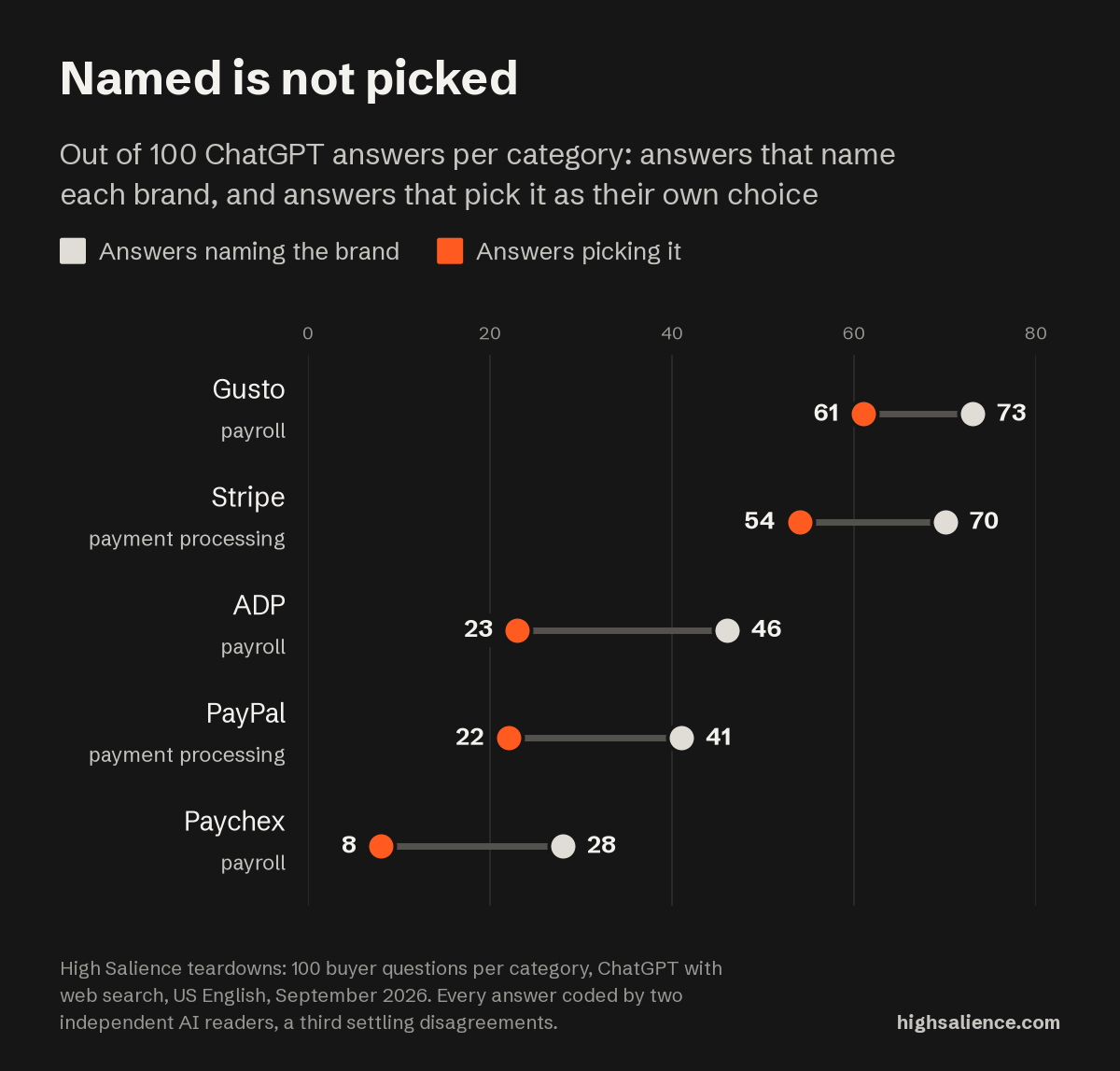
| Brand | Category | Answers naming it | Recommending it | Picking it |
|---|---|---|---|---|
| Stripe | Payment processing | 70 | 68 | 54 |
| PayPal | Payment processing | 41 | 39 | 22 |
| Gusto | Payroll | 73 | 73 | 61 |
| ADP | Payroll | 46 | 45 | 23 |
| Paychex | Payroll | 28 | 26 | 8 |
PayPal and ADP are among the best-known brands in their categories. ChatGPT describes a use case for them almost every time it names them, and makes them its own pick about half the time, much less often than the brands next to them. A mention count would rate them well. A pick count shows the real picture. You can see every brand's split on our brand pages.
04Value
What is the value of a brand mention in AI answers?
The value of a brand mention in AI answers depends on the role it plays in the answer, so no tool can put a fixed price on one. A pick, where the answer chooses you for the buyer's situation, works like advice from someone the buyer already trusts. A name halfway down a list of ten works like a directory entry.
Where your brand sits in the answer is a fair guide to which kind you got. In our 2,100 ChatGPT answers, a brand named in the first three places was the answer's own pick 88 percent of the time, and a brand named sixth or later 57 percent:
| Position in the answer | Appearances | Picked | Pick rate |
|---|---|---|---|
| 1st to 3rd | 5,072 | 4,464 | 88% |
| 4th or 5th | 1,938 | 1,327 | 68% |
| 6th or later | 1,208 | 684 | 57% |
Position is counted from each brand's first appearance, across the same 8,218 appearances counted earlier on this page. Three things decide what a mention is worth to the business:
- Whether the answer picks you. A pick shapes the decision. A listing only puts you in the set the buyer goes on to compare, often against the brand the answer did pick.
- Whether it links to you. A citation can send the visit a bare mention can't. In Seer Interactive's 2026 data on 53 brands, a brand earned 120 percent more organic clicks per impression when its site was cited in the AI Overview than when it wasn't, though still 38 percent fewer than on searches with no Overview at all.
- Whether it repeats. One mention in one answer is an anecdote. The value comes from being picked across the questions buyers actually ask, run after run.
What happens after the answer is harder to pin down. Profound's panel study, from a company that sells AI visibility tools, found that an AI answer naming a brand lifted visits to the brand's site over the next seven days to between 1.5 and 2.5 times the expected rate, depending on the platform, and more than 97 percent of the visits that followed ChatGPT mentions carried no tracking tag, so analytics never credits the answer. On what a visit from AI is worth, the evidence splits: Ahrefs reported AI search visitors converting at 23 times the rate of organic visitors on its own site, while a peer-reviewed study of 973 online stores found ChatGPT referrals converting below every traditional channel except paid social.
That is why we report pick share on buying questions rather than a count of mentions or a tally of AI referral visits.
05Why Monitor
Why you should monitor brand mentions in AI search results
You should monitor brand mentions in AI search results because more of a buyer's research now ends inside the answer, and nothing in your analytics records what it said about you. Five reasons matter most:
- Clicks no longer show it. In Pew Research Center's study of US adults' browsing, people clicked a regular result on 8 percent of visits when an AI summary appeared, against 15 percent when none did. A buyer can read an answer that names you, or leaves you out, and never reach your site. Our zero-click search guide has the wider numbers.
- Being named is not being picked. The payroll numbers above show a well-known brand named in 28 answers and picked in 8. Only tracking both tells you which problem you have.
- Answers change from run to run. Ask the same question twice and the brands can change, so one check is an anecdote. The same question set run every month shows the trend.
- Errors travel. An old price or a retired plan on a review site can resurface in answers. Monitoring shows you the wrong description so you can fix the page it came from.
- Competitors are in your answers. Each answer shows which rival the model prefers for which case, something rankings alone never tell you.
A spreadsheet and a monthly run of the same buyer questions are enough to start. If you would rather pay for software, our comparison of ChatGPT SEO tracking tools covers what each one checks and where they fall short.
06How To
How to turn mentions into AI recommendations
Turning mentions into AI recommendations starts with measuring the gap between the two.
- Measure both numbers. Track how often you are named and how often you are picked, per question type. The gap tells you whether the problem is awareness or positioning.
- Fix the description, not just the frequency. AI answers pick brands for stated cases. If sources describe you vaguely, you will be described and not picked. Make who you are for, what you cost and what you do best easy to find on your own site.
- Correct the sources AI reads. Review profiles, comparison articles and directories that describe you inaccurately feed straight into answers. Our AI citations guide shows where ChatGPT's sources come from.
- Earn mentions with something worth citing. Original data, clear comparisons and first-hand expertise get referenced. Rewrites of what already ranks do not.
- Skip the shortcuts. Bought mentions and fake reviews are exactly what Google says you do not need, and they carry legal risk of their own.
07Where This Fits
Brand mentions in an AI SEO program
In an AI SEO program, brand mentions are the raw material. Pick share is the outcome. Moving from one to the other is the core of generative engine optimization: measure where you are named and not picked, find the sources behind those answers, and fix what they say. For the measurement side, see AI visibility and AI share of voice. For software brands, closing the gap between named and picked is the center of our B2B SaaS SEO work.
If you want outside help with this, our list of AI SEO agencies compares 18 firms on what they publish about their work.
08FAQs
Brand mentions FAQs
Brand mentions raise four practical questions, from unlinked mentions to paying for coverage.
Do unlinked brand mentions help SEO?
Google has not published a rule that counts unlinked brand mentions as a ranking signal, and it says you do not need to chase mentions for its AI features. What mentions clearly do is shape what people and AI systems read about you. A brand that appears accurately in the sources a category relies on is easier to recommend.
What is the difference between a brand mention and a recommendation?
A brand mention means your name appears, while a recommendation means the answer assigns you to a stated case, such as "best for small teams". A pick means the answer itself chooses you. In our 21 software teardowns, 21 percent of brand appearances were not the answer's pick.
How do I track brand mentions in AI answers?
To track brand mentions in AI answers, run a fixed set of buyer questions on each AI surface, save the full answers, and code each brand as picked, recommended, listed or passing using written rules. Repeat monthly against the same competitors. Our AI visibility guide lays out the method.
Should I pay for brand mentions?
No, you should not pay for brand mentions. Google lists inauthentic mentions as something you do not need to pursue, and paid placements that are not disclosed can create legal and trust problems. Earn mentions by being worth citing: original data, clear pricing and accurate profiles on the sites your buyers already read.
09Sources
Sources and further reading
- Google Search Central: Optimizing your website for generative AI features on Google Search
- Pew Research Center (2025): Google users are less likely to click on links when an AI summary appears in the results
- High Salience: payment processing teardown (dataset)
- High Salience: payroll teardown (dataset)
- Seer Interactive (2026): AI Overview impact on Google CTR, 2026 update
- Profound (2026): The AI mention effect
- Ahrefs (2025): AI search traffic conversions on ahrefs.com
- Kaiser and Schulze (2026), Marketing Science: ChatGPT referrals to e-commerce websites
10Next Step
Find out if AI answers name your brand or recommend it
Every High Salience engagement starts with the Category Salience Brief, which shows whether AI answers name your brand or recommend it: your commercial questions run across Google and the AI surfaces, competitors side by side, and a ranked list of what to fix first.