HIGH SALIENCE / RESEARCH / APPLICANT TRACKING TEARDOWN
TEARDOWN 09 · PUBLISHED SEPTEMBER 26, 2026 · DATASET INCLUDED
100 Questions, Ninth Category: Applicant Tracking, Where the Leaders Rank Least and a Comparison Site Nobody Ranks Is Cited in 13 Answers
Ninth category, same method: 100 applicant tracking system queries, ChatGPT with web search on, every answer coded under the rulebook the earlier teardowns used, Google's top ten as a control. Four brands lead, the answers split cleanly by buyer type, and this is the category where Google and ChatGPT agree least: 84 percent of recommendations went to brands whose own site did not rank for the question, and one comparison site that ranked for none of them was cited in 13 answers.
01Method
Same query structure, same coding, one new category.
Queries: 100 applicant tracking software queries built from the same templates as the earlier teardowns: 30 category, 30 comparison, 20 alternative and 20 recommendation. The full list is in the dataset.
Surface: ChatGPT with web search forced on, logged out, United States, English, via the DataForSEO scraper, one run per query, collected September 26, 2026.
Control: Google's top ten organic results for the same queries in the same window, via the DataForSEO SERP API at depth 20 and truncated to the first ten organic results.
Coding: every brand named was coded as recommended (selected for a stated case), listed (in a table or list without being chosen), passing, or anchor (the brand being replaced in an "alternatives" query), against a 51-brand dictionary fixed before coding (see the collection note), under codebook v1.5. Cited URLs were deduplicated to their domain and classed as first-party or third-party. Five answers drawn with a fixed seed were hand-checked: 24 coded mentions, 20 agreed with the reader. All four disagreements are in one answer: three conditional picks separated by bold markup were coded listed, and BambooHR, named only in a question back to the buyer, was coded recommended. They are left in the data as coded and documented in coder-notes.md.
Collection note: the ChatGPT answers and the Google controls were collected on September 26, 2026 through the DataForSEO standard queue, with raw responses saved exactly as returned. Greenhouse is matched on both greenhouse.com and its earlier domain greenhouse.io, which it still uses for job boards; the coder was extended to accept more than one domain per brand, and re-coding two earlier categories with the extended coder reproduced their published files exactly. Fifteen aliases that are also ordinary words (Greenhouse, Lever, Workable, Fountain and others) match only when capitalized.
One run per query, so this is a teardown, not the benchmark. Frequencies describe this window only. Absence means not observed in this sample, never zero visibility.
02Findings
Four leaders, clean lanes, and the widest gap from Google yet.
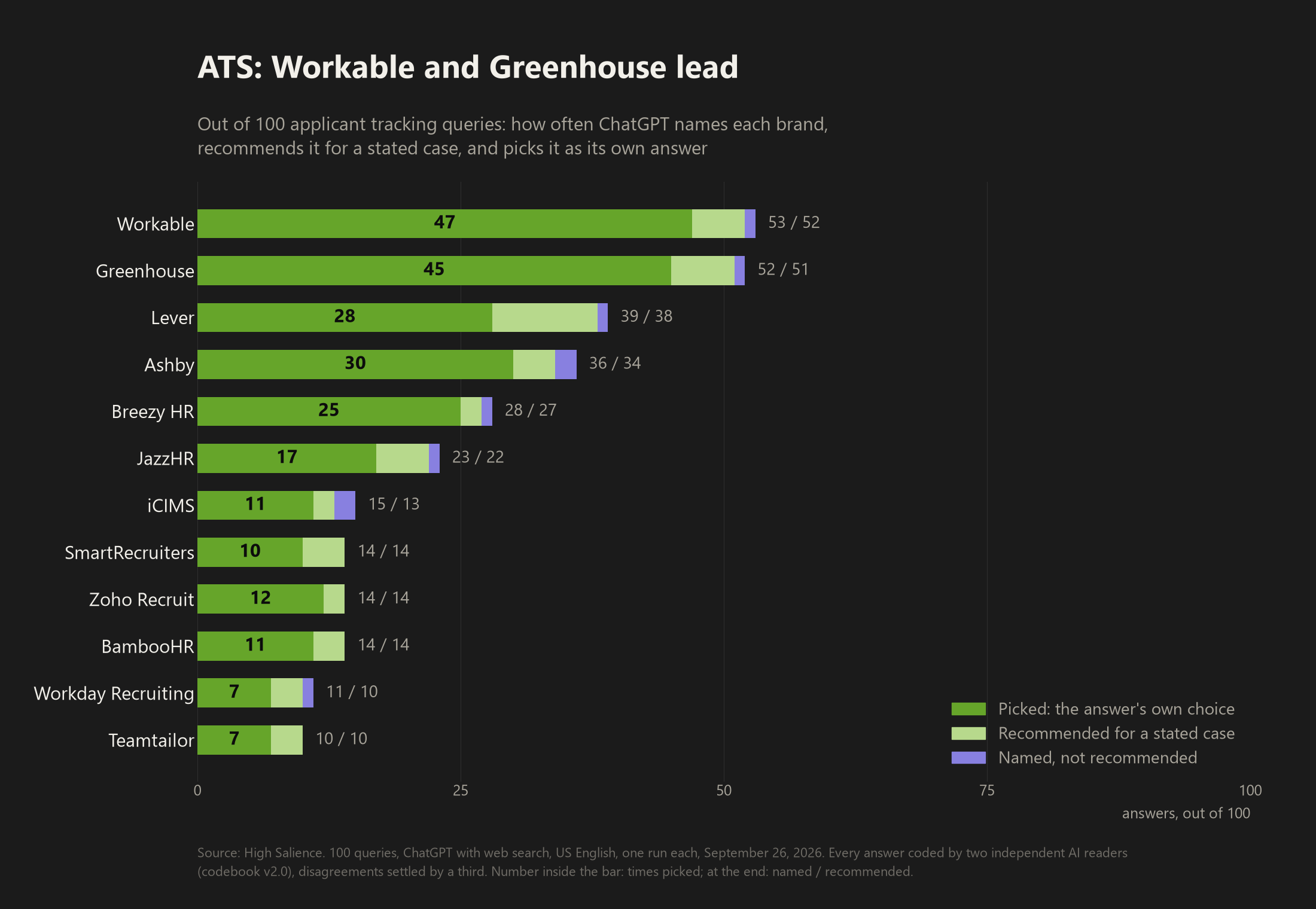
| Brand | Appears in | Recommended in | Recommended share of appearances |
|---|---|---|---|
| Greenhouse | 56 | 34 | 61% |
| Workable | 53 | 32 | 60% |
| Lever | 43 | 22 | 51% |
| Ashby | 38 | 23 | 61% |
| Breezy HR | 28 | 13 | 46% |
| JazzHR | 27 | 11 | 41% |
| BambooHR | 23 | 16 | 70% |
| Workday Recruiting | 23 | 10 | 43% |
| iCIMS | 16 | 10 | 62% |
| Zoho Recruit | 14 | 10 | 71% |
| SmartRecruiters | 14 | 8 | 57% |
| Teamtailor | 13 | 5 | 38% |
Each linked brand has its own page: how ChatGPT recommends every brand in this dataset, with positioning labels, head-to-head results and sources.
Out of 100 answers, codebook v1.5. "Recommended" means the answer selected the brand for a stated case. "Appears" adds brands listed in a table or bullet list without being chosen. The brand being replaced in an "alternatives" query is excluded from both columns.
Four brands lead
Greenhouse is named in 56 answers and recommended in 34. Workable is named in 53 and recommended in 32, Lever 43 and 22, Ashby 38 and 23. On the 20 direct advice questions, 18 produced a pick from the dictionary: Greenhouse was among them in 11, Workable and Ashby in 10 each, Lever in 7. Breezy HR and JazzHR are named often, 28 and 27 times, and chosen in 13 and 11.
The lanes are clean
ChatGPT sorts this category by buyer type. Engineering hiring goes to Ashby, Greenhouse and Lever. Enterprise questions go to iCIMS, Workday Recruiting, Greenhouse and SmartRecruiters. Hourly and restaurant hiring goes to Fountain and Paradox, with iCIMS and UKG added when the question says at scale. Staffing and recruiting agencies get Bullhorn, Loxo, Recruit CRM and Manatal, vendors built for agencies. Free and open source alternatives to Greenhouse get OpenCATS.
Caution, but less in head-to-heads
Twenty-four answers recommended no dictionary brand, behind only payroll (28). The head-to-heads were more decisive than in HR: 22 of 30 recommended every brand named, and five recommended none, including Lever versus Workable, Workable versus Ashby, and Greenhouse versus Lever versus Workable. One comparison answer, Lever versus Teamtailor, warned that much of the side-by-side material it found was published by one of the two vendors.
The widest gap from Google
Of the 242 recommended brand mentions, 203 were for brands whose own website does not rank in Google's top ten organic results for that query, 84 percent, the highest of any category so far. Google's top ten for these queries is 87 percent third-party pages, also the highest.
A comparison site nobody ranks
Across 100 answers there were 311 citation events to 110 domains. Vendors' own sites took 139 of them, 45 percent. lever.co is the most-cited domain, in 26 answers, 17 of them to questions that never mention Lever. The most-cited third party is Capterra (15), followed by yardstick.team, cited in 13 answers across nine different pages: ATS comparisons, pricing and "alternatives" pages. yardstick.team ranked in Google's top ten for none of those 13 questions. It is the same pattern as the help desk and HR teardowns: a site that publishes a systematic set of comparison pages becomes part of the model's reading list without ranking. Reddit and Wikipedia have zero citations, for the ninth teardown running.
Fifty-nine of the 311 citation events involved a domain that also sat in Google's top ten for that query, 19 percent, the lowest overlap in the series.
039 categories, side by side
Same rulebook, every category so far.
| Measure (codebook v1.5) | Project management, Sept 8 | CRM, Sept 17 | Email marketing, Sept 17 | Help desk, Sept 17 | Accounting, Sept 17 | Payment processing, Sept 17 | Payroll, Sept 21 | HR software, Sept 26 | Applicant tracking, Sept 26 |
|---|---|---|---|---|---|---|---|---|---|
| Recommendations per category answer (average) | 4.8 | 3.3 | 3.3 | 3.9 | 3.1 | 2.3 | 2.0 | 3.2 | 2.7 |
| Answers with no recommended dictionary brand | 5 of 100 | 13 of 100 | 7 of 100 | 8 of 100 | 9 of 100 | 14 of 100 | 28 of 100 | 23 of 100 | 24 of 100 |
| Most-recommended brand: appears / recommended | Asana 76 / 68 | HubSpot 77 / 62 | Mailchimp 61 / 40 | Zendesk 74 / 54 | QuickBooks 75 / 58 | Stripe 73 / 53 | Gusto 76 / 47 | Gusto 51 / 39 | Greenhouse 56 / 34 |
| Head-to-head queries recommending every named brand | 29 of 30 | 26 of 30 | 30 of 30 | 28 of 30 | 27 of 30 | 21 of 30 | 18 of 30 | 19 of 30 | 22 of 30 |
| Recommendation-intent queries with a dictionary pick | 18 of 20 | 16 of 20 | 17 of 20 | 18 of 20 | 19 of 20 | 18 of 20 | 14 of 20 | 17 of 20 | 18 of 20 |
| Recommended mentions where the brand does not rank in Google's top 10 | 305 of 368 (83%) | 187 of 287 (65%) | 216 of 309 (70%) | 255 of 336 (76%) | 136 of 268 (51%) | 160 of 210 (76%) | 87 of 191 (46%) | 192 of 259 (74%) | 203 of 242 (84%) |
| Google top 10 that is third-party pages | 746 of 1,000 (75%) | 710 of 1,000 (71%) | 720 of 1,000 (72%) | 714 of 1,000 (71%) | 743 of 1,000 (74%) | 787 of 1,000 (79%) | 653 of 1,000 (65%) | 820 of 1,000 (82%) | 871 of 1,000 (87%) |
| Citation events to vendors' own sites | 216 of 362 (60%) | 136 of 320 (42%) | 193 of 367 (53%) | 152 of 345 (44%) | 125 of 302 (41%) | 161 of 301 (53%) | 192 of 314 (61%) | 167 of 325 (51%) | 139 of 311 (45%) |
| Answers citing only vendor pages | 50 of 100 | 40 of 100 | 37 of 100 | 27 of 100 | 34 of 100 | 47 of 100 | 49 of 100 | 34 of 100 | 30 of 100 |
| Share of citations in the 10 most-cited domains | 54% | 40% | 42% | 45% | 55% | 58% | 55% | 46% | 44% |
| Citation events whose domain is in Google's top 10 | 83 of 362 (23%) | 83 of 320 (26%) | 97 of 367 (26%) | 80 of 345 (23%) | 99 of 302 (33%) | 98 of 301 (33%) | 134 of 314 (43%) | 85 of 325 (26%) | 59 of 311 (19%) |
| Reddit and Wikipedia citations | 0 | 0 | 0 | 0 | 0 | 0 | 0 | 0 | 0 |
All columns are coded under codebook v1.5; the project management column is the September 8 dataset recoded under it. Each teardown is one run per query in its own window, so differences between columns mix category with collection date.
04What this changes
Four things, in order.
Ranking is the weakest predictor yet. In this category 84 percent of ChatGPT's recommendations went to brands that did not rank for the question. Google visibility and AI visibility have to be measured, and worked on, separately.
Comparison libraries get read. A site with nine comparison and alternatives pages was cited in 13 answers without ranking for any of them. If a library like that covers your category, it is part of your AI search footprint whether you know it or not.
Own your lane in plain words. ChatGPT sends engineering hiring, enterprise, hourly and agency buyers to different vendors. The vendors that win a lane are the ones whose pages say which buyer they are for.
Your own site is read for your competitors' questions. lever.co was cited in 17 answers to questions that do not mention Lever. Vendor comparison and guide pages are some of the most-read material in the category.
05Limitations
What this teardown cannot tell you.
One run per query means answer variance is unmeasured; Benchmark 01 runs each query three times across three surfaces. The teardowns are collected on different days, so differences between categories mix the category with the date. The brand dictionary covers the general applicant tracking software market and deliberately excludes vertical tools, so their appearances are described in prose and not counted. The rule-based coder has one known failure: a brand named as a contrast on the same line as a selecting verb is coded as recommended. Sentiment coding is rule-based and not reported. No vendor-tool cross-check was read for this category. Google's control counts a brand as ranking only when its own domain is in the top ten; a listicle that features the brand does not count. One run per question, one day, United States, English, logged out. Answers vary between runs, so these are frequencies for this sample. The hand check agreement (20 of 24) is lower than in some earlier teardowns, and the known coding errors are listed in coder-notes.md rather than corrected. Recruiterflow and JobAdder appeared in agency answers but are not in the dictionary, so agency results undercount them.
06Dataset
Check it, don't believe it.
Every number above can be recomputed from these files. CC BY 4.0: use them, cite the page.
- queries.csv: the 100 queries with intent labels.
- brands.csv: the 51-brand dictionary with aliases and canonical domains.
- mentions.csv: 476 coded brand mentions with position, type and whether the brand's domain was in Google's top ten.
- citations.csv: 311 citation events with domain class and Google overlap.
- observations.csv: one row per query with brand, recommendation, citation and control counts.
- coder-notes.md: hand-check results, dictionary notes and known coding disagreements, left uncorrected in the data
- codebook.md: the rulebook, with dated amendments through v1.5.
The earlier teardowns: Teardown 01, project management, Teardown 02, crm, Teardown 03, email marketing, Teardown 04, help desk, Teardown 05, accounting, Teardown 06, payment processing, Teardown 07, payroll, Teardown 08, hr software.
Nine categories, and the reading list is still the story.
In applicant tracking the model's picks track vendor pages and a comparison library that does not rank. In HR they track one comparison page. In payroll, one vendor's website. Finding out what the model is reading for your category is the first thing a Category Salience Brief does, with a query set you approve first.