HIGH SALIENCE / RESEARCH / ECOMMERCE PLATFORM TEARDOWN
TEARDOWN 14 · PUBLISHED SEPTEMBER 26, 2026 · DATASET INCLUDED
100 Questions, Fourteenth Category: Ecommerce Platforms, Where ChatGPT Picks Shopify in 69 Answers and Cites Shopify's Own Site in 67
Fourteenth category, same method: 100 ecommerce platform queries, ChatGPT with web search on, every answer coded by two independent AI readers, Google's top ten as a control. Shopify appears as an option in 75 answers, and in 69 the answer picks it as its own choice, 29 more than the next brand, WooCommerce (40). In 10 answers Shopify is the only brand picked, the most for any brand in the series so far. Much of what the model reads on the way there is Shopify's own website: shopify.com is cited in 67 answers, more than any domain in any earlier teardown, including 47 answers to questions that never mention Shopify.
01Method
Same query structure, same coding, one new category.
Queries: 100 ecommerce platforms queries built from the same templates as the earlier teardowns: 30 category, 30 comparison, 20 alternative and 20 recommendation. The full list is in the dataset.
Surface: ChatGPT with web search forced on, logged out, United States, English, via the DataForSEO scraper, one run per query, collected September 26, 2026.
Control: Google's top ten organic results for the same queries in the same window, via the DataForSEO SERP API at depth 20 and truncated to the first ten organic results.
Coding: every answer was coded by two independent AI readers (Claude agents working blind from a written protocol), with a third settling disagreements. They were not people. Each brand named was coded picked (the answer's own verdict: "my pick", "choose X if", a shortlist it tells you to act on, the #1 of its ranking), recommended (assigned to a stated case or fit, such as "best for small teams", without being the answer's verdict), listed (named as an option, no fit given), passing (named but not offered as an option) or anchor (the brand being replaced in an "alternatives" query), against a 51-brand dictionary fixed after collection, before the final coding run (every change is listed in DICTIONARY_CHANGES.md), under codebook v2.0. "Recommended" in the tables includes picked brands. The two readers agreed on 97.8% of brand codes in this teardown (100.0% at the recommended level). Cited URLs were deduplicated to their domain and classed as first-party or third-party. The third reader decided 9 of the 411 brand codes in this teardown. A rules-based first pass (the codebook v1.6 rules) agreed with the final codes on 96.8 percent at the recommended level; only the reader codes are published. The readers also coded one brand mention that no dictionary alias matched (named by meaning or only by a web address); those rows are in the dataset.
Collection note: the ChatGPT answers and the Google controls were collected on September 26, 2026 through the DataForSEO standard queue, with raw responses saved exactly as returned; the raw files carry UTC timestamps, early September 27. No task failed and none was re-run. Three answers came back as a single sentence with no choice and no citations, and are coded as returned. After collection, before the final coding run, three vendor addresses were added to the dictionary so they count as the vendors' own sites: shopify.dev for Shopify, and bigcommerce.co.uk and bigcommerce.com.au for BigCommerce. No brand name or alias changed; the effect is four citation events moved from third-party to first-party. Shopify Plus counts as Shopify, Adobe Commerce as Magento, and any capitalized "Square" as Square Online. Amazon and eBay are left out as marketplaces. Five aliases that are also ordinary words (Square, Medusa, Swell, Faire, Lightspeed) match only when capitalized. Both dictionaries and the list of changes ship with the dataset.
One run per query, so this is a teardown, not the benchmark. Frequencies describe this window only. Absence means not observed in this sample, never zero visibility.
02Findings
One default, specialists beside it, and a reading list the leader wrote.
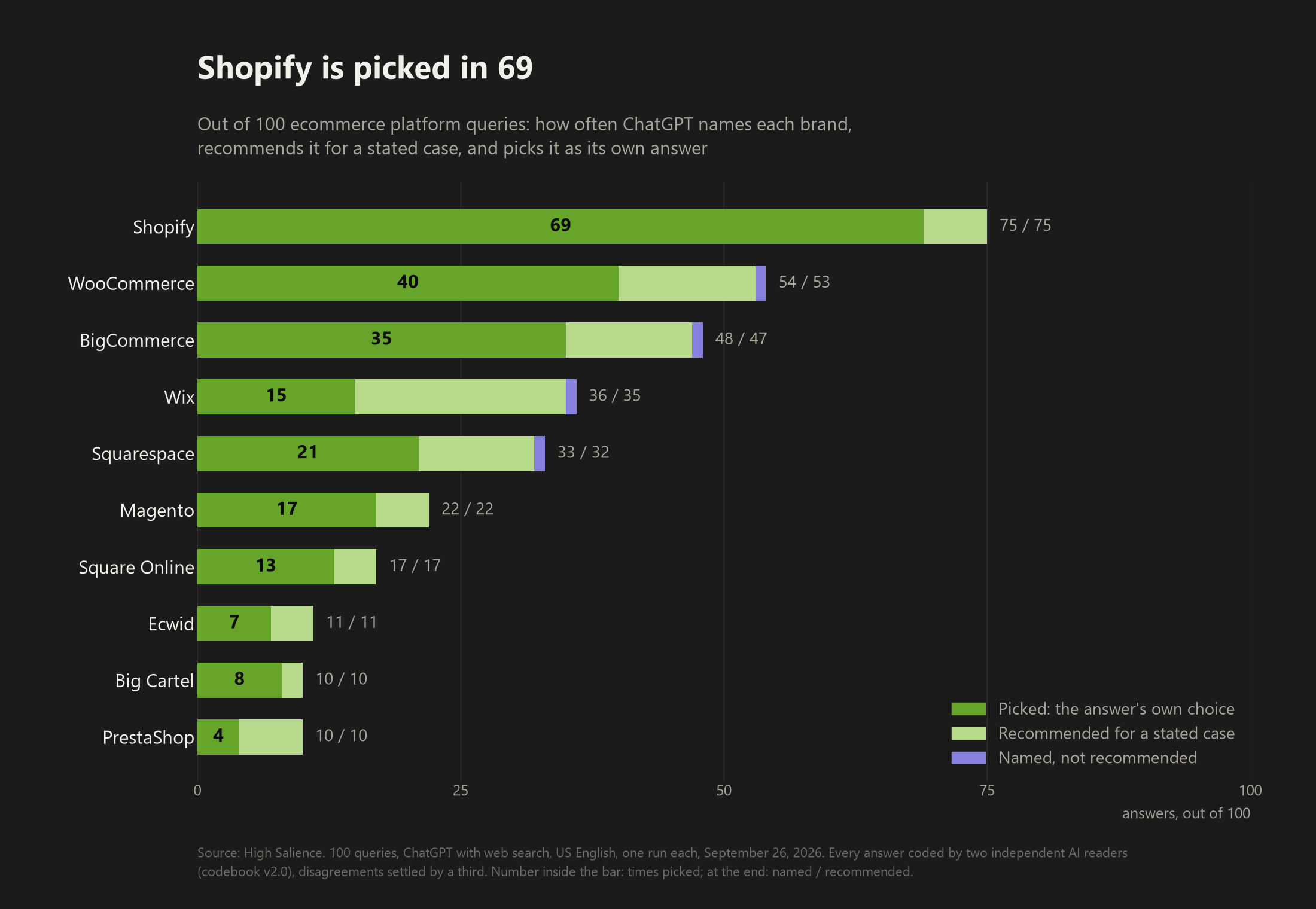
| Brand | Appears in | Recommended in | Picked in | Picked share of appearances |
|---|---|---|---|---|
| Shopify | 75 | 75 | 69 | 92% |
| WooCommerce | 54 | 53 | 40 | 74% |
| BigCommerce | 48 | 47 | 35 | 73% |
| Wix | 36 | 35 | 15 | 42% |
| Squarespace | 33 | 32 | 21 | 64% |
| Magento | 22 | 22 | 17 | 77% |
| Square Online | 17 | 17 | 13 | 76% |
| Ecwid | 11 | 11 | 7 | 64% |
| Big Cartel | 10 | 10 | 8 | 80% |
| PrestaShop | 10 | 10 | 4 | 40% |
Each linked brand has its own page: how ChatGPT recommends every brand in this dataset, with positioning labels, head-to-head results and sources.
Out of 100 answers, codebook v2.0. "Picked" means the answer itself chose the brand as its verdict, overall or for a case. "Recommended" means the answer assigned the brand to a stated case or fit, and includes picked brands. "Appears" adds brands named as an option with no fit. The brand being replaced in an "alternatives" query is excluded from all columns.
Shopify is the answer's own pick in 69 of 100
Shopify appears as an option in 75 answers, is recommended for a stated case in all 75 and is picked as the answer's own choice in 69. WooCommerce is second at 54 / 53 / 40, then BigCommerce at 48 / 47 / 35. Shopify's lead of 29 picks over the second brand is the second widest in the series so far, behind payroll (Gusto 61, Rippling 26). In 10 answers Shopify is the only brand picked, the most for any brand so far; the previous high was Gusto, with 7. It is picked in 18 of the 20 direct advice questions, in 15 of the 17 head-to-heads that name it and in 54 of the 76 answers to questions that do not mention it. When the answer picks a second platform alongside it, that is most often BigCommerce (26 answers) or WooCommerce (25).
Specialists get picked next to Shopify, rarely instead of it
Nineteen category questions narrow the need: clothing, dropshipping, B2B, headless, large catalogs and so on. Shopify is picked in 18 of them; the 19th, about high-volume sellers, picks nothing. Specialists mostly arrive beside it. Print on demand picks Shopify plus Printful and Printify. Both subscription questions pick Shopify alone, with subscription apps that are not in the dictionary. On the four questions about a local shop, a bakery or selling in person, Shopify is picked in all four and Square Online in three. Shopify is also picked in 12 of the 13 alternatives questions that do not name it, and it is the only pick for Wix alternatives and for Ecwid alternatives. The lanes where someone else takes over are narrow and clear. The digital products advice question picks Payhip, Lemon Squeezy and Gumroad and not Shopify. Medusa and Saleor are picked in all 6 answers that name them, on headless, open source and developer questions. OroCommerce is picked in all 3 of its answers, all about B2B wholesale.
Described, not picked
Among brands that appear in 15 or more answers, the widest gap between being recommended for a case and being picked belongs to Wix: it appears in 36 answers, is recommended in 35 and picked in 15. WooCommerce is next (53 recommended, 40 picked), then BigCommerce (47, 35) and Squarespace (32, 21). Wix is picked in all 4 head-to-heads that name it, but in category questions it appears in 15 answers and is picked in 4. In the 20 answers that give Wix a fit without picking it, Shopify is picked in 17 and two pick nothing. Wix gets a row in the table; the verdict goes elsewhere.
Shopify writes much of the reading list
Across 100 answers there were 277 citation events to 95 domains. Vendors' own sites took 194 of them, 70 percent, second only to data warehouse and ETL (74 percent) so far, and 55 answers cited nothing but vendor pages. shopify.com alone is cited in 67 answers, a quarter of all citation events and more than any single domain in any earlier teardown (the previous high was gusto.com, 65, in payroll). Forty-seven of those 67 answers are to questions that never mention Shopify, and Shopify is picked in 43 of them. In the 29 answers to such questions that do not cite shopify.com, it is picked in 11. Much of what is read is Shopify's own comparison and roundup articles: 11 pages on its blog and enterprise blog, cited in 36 answers, 31 of them to questions that do not name Shopify, and Shopify is picked in 28 of those 31. One enterprise platform comparison is cited in 14 answers; shopify.com ranked in Google's top ten for only 3 of those 14 questions. Five of the seven questions about alternatives to Shopify cite shopify.com. No independent site is cited in more than 5 answers (technologyadvice.com), and Reddit and Wikipedia have zero citations, for the fourteenth teardown running.
Decisive answers, far from Google
Ninety-three of the 100 answers pick at least one brand. Three of the seven that do not are one-sentence replies. The other four give every brand a fit and stop short of a verdict: the two broadest questions, "best ecommerce platform" and the same question with 2026 added, the high-volume sellers question, and Shopify vs Magento, where each side gets a "tends to make sense if" list. Twenty-seven of the 30 head-to-heads pick every brand named, and 19 of the 20 advice questions pick something. Of the 285 picks, 227 went to brands whose own website did not rank in Google's top ten for the question, 80 percent; Shopify's own site ranked for 21 of its 69. Google's top ten is 87 percent third-party pages, level with applicant tracking and password managers as the highest in the series so far.
Fifty-six of the 277 citation events involved a domain that also sat in Google's top ten for that query, 20 percent.
0314 categories, side by side
Same rulebook, every category so far.
| Measure (codebook v2.0) | Project management, Sept 8 | CRM, Sept 17 | Email marketing, Sept 17 | Help desk, Sept 17 | Accounting, Sept 17 | Payment processing, Sept 17 | Payroll, Sept 21 | HR software, Sept 26 | Applicant tracking, Sept 26 | Password managers, Sept 26 | Endpoint security, Sept 26 | Business intelligence, Sept 26 | Data warehouse and ETL, Sept 26 | Ecommerce platforms, Sept 26 |
|---|---|---|---|---|---|---|---|---|---|---|---|---|---|---|
| Recommendations per category answer (average) | 5.9 | 4.3 | 5.0 | 5.5 | 4.3 | 4.2 | 4.6 | 5.0 | 4.5 | 3.4 | 4.7 | 5.0 | 4.5 | 4.3 |
| Answers with no recommended dictionary brand | 1 of 100 | 5 of 100 | 1 of 100 | 1 of 100 | 0 of 100 | 5 of 100 | 1 of 100 | 6 of 100 | 5 of 100 | 3 of 100 | 3 of 100 | 3 of 100 | 2 of 100 | 3 of 100 |
| Answers with no pick (the answer's own verdict) | 2 of 100 | 11 of 100 | 2 of 100 | 4 of 100 | 9 of 100 | 22 of 100 | 19 of 100 | 17 of 100 | 12 of 100 | 7 of 100 | 7 of 100 | 5 of 100 | 3 of 100 | 7 of 100 |
| Most-recommended brand: appears / recommended | Asana 73 / 73 | HubSpot 75 / 74 | Mailchimp 58 / 56 | Zendesk 70 / 69 | QuickBooks 75 / 73 | Stripe 70 / 68 | Gusto 73 / 73 | Rippling 58 / 57 | Workable 53 / 52 | Bitwarden 84 / 82 | Microsoft Defender 68 / 67 | Power BI 75 / 73 | Snowflake 50 / 50 | Shopify 75 / 75 |
| Most-picked brand: appears / picked | Asana 73 / 70 | HubSpot 75 / 69 | Mailchimp 58 / 44 | Zendesk 70 / 61 | QuickBooks 75 / 65 | Stripe 70 / 54 | Gusto 73 / 61 | Rippling 58 / 50 | Workable 53 / 47 | Bitwarden 84 / 78 | Microsoft Defender 68 / 62 | Power BI 75 / 69 | Snowflake 50 / 46 | Shopify 75 / 69 |
| Head-to-head queries recommending every named brand | 30 of 30 | 28 of 30 | 30 of 30 | 29 of 30 | 26 of 30 | 28 of 30 | 30 of 30 | 28 of 30 | 29 of 30 | 28 of 30 | 30 of 30 | 29 of 30 | 28 of 30 | 28 of 30 |
| Head-to-head queries picking every named brand | 30 of 30 | 23 of 30 | 29 of 30 | 29 of 30 | 25 of 30 | 19 of 30 | 21 of 30 | 21 of 30 | 29 of 30 | 27 of 30 | 29 of 30 | 29 of 30 | 28 of 30 | 27 of 30 |
| Recommendation-intent queries with a dictionary recommendation | 19 of 20 | 18 of 20 | 20 of 20 | 20 of 20 | 20 of 20 | 19 of 20 | 20 of 20 | 18 of 20 | 20 of 20 | 19 of 20 | 19 of 20 | 20 of 20 | 20 of 20 | 19 of 20 |
| Recommendation-intent queries with a pick | 19 of 20 | 18 of 20 | 20 of 20 | 20 of 20 | 19 of 20 | 18 of 20 | 20 of 20 | 18 of 20 | 20 of 20 | 19 of 20 | 19 of 20 | 20 of 20 | 20 of 20 | 19 of 20 |
| Recommended mentions where the brand does not rank in Google's top 10 | 398 of 468 (85%) | 269 of 387 (70%) | 313 of 419 (75%) | 350 of 445 (79%) | 206 of 368 (56%) | 294 of 360 (82%) | 202 of 383 (53%) | 310 of 405 (77%) | 333 of 388 (86%) | 218 of 304 (72%) | 273 of 369 (74%) | 355 of 401 (89%) | 360 of 426 (85%) | 313 of 376 (83%) |
| Picked mentions where the brand does not rank in Google's top 10 | 349 of 416 (84%) | 226 of 330 (68%) | 270 of 370 (73%) | 291 of 380 (77%) | 141 of 279 (51%) | 170 of 222 (77%) | 113 of 246 (46%) | 232 of 311 (75%) | 261 of 311 (84%) | 163 of 241 (68%) | 231 of 319 (72%) | 292 of 336 (87%) | 303 of 365 (83%) | 227 of 285 (80%) |
| Google top 10 that is third-party pages | 746 of 1,000 (75%) | 710 of 1,000 (71%) | 720 of 1,000 (72%) | 714 of 1,000 (71%) | 743 of 1,000 (74%) | 787 of 1,000 (79%) | 653 of 1,000 (65%) | 820 of 1,000 (82%) | 871 of 1,000 (87%) | 866 of 1,000 (87%) | 778 of 1,000 (78%) | 823 of 999 (82%) | 777 of 1,000 (78%) | 868 of 1,000 (87%) |
| Citation events to vendors' own sites | 216 of 362 (60%) | 136 of 320 (42%) | 193 of 367 (53%) | 152 of 345 (44%) | 125 of 302 (41%) | 161 of 301 (53%) | 192 of 314 (61%) | 167 of 325 (51%) | 139 of 311 (45%) | 201 of 292 (69%) | 149 of 266 (56%) | 190 of 274 (69%) | 197 of 267 (74%) | 194 of 277 (70%) |
| Answers citing only vendor pages | 50 of 100 | 40 of 100 | 37 of 100 | 27 of 100 | 34 of 100 | 47 of 100 | 49 of 100 | 34 of 100 | 30 of 100 | 65 of 100 | 44 of 100 | 60 of 100 | 60 of 100 | 55 of 100 |
| Share of citations in the 10 most-cited domains | 54% | 40% | 42% | 45% | 55% | 58% | 55% | 46% | 44% | 72% | 58% | 62% | 60% | 61% |
| Citation events whose domain is in Google's top 10 | 83 of 362 (23%) | 83 of 320 (26%) | 97 of 367 (26%) | 80 of 345 (23%) | 99 of 302 (33%) | 98 of 301 (33%) | 134 of 314 (43%) | 85 of 325 (26%) | 59 of 311 (19%) | 78 of 292 (27%) | 72 of 266 (27%) | 44 of 274 (16%) | 54 of 267 (20%) | 56 of 277 (20%) |
| Reddit and Wikipedia citations | 0 | 0 | 0 | 0 | 0 | 0 | 0 | 0 | 0 | 0 | 0 | 0 | 0 | 0 |
All columns are coded under codebook v2.0 by two independent AI readers per answer; the project management column is the September 8 dataset recoded under it. Each teardown is one run per query in its own window, so differences between columns mix category with collection date.
04What this changes
Four things, in order.
Write the comparison your buyers ask about. Shopify's comparison and roundup articles were cited in 36 answers, 31 of them to questions that do not name Shopify, and Shopify was picked in 28 of those 31. Ranking was not required: its most-cited comparison page was read for 14 questions and shopify.com ranked for 3 of them.
Earn the sentence after the table. Wix is recommended for a case in 35 answers and picked in 15. A row in the comparison grid is visibility; the pick is the sentence that follows it, and that is the sentence to earn.
Own a lane in plain words. Where the default does not fit, the model picks the specialist that says clearly who it is for: Medusa and Saleor in every answer that names them, Payhip, Lemon Squeezy and Gumroad for digital products, OroCommerce for B2B wholesale.
Connect your old and new names. When a question does not name Magento, the answer calls it only Adobe Commerce in 14 of 18. If your product has been renamed, make sure your own pages tie the two names together, and track both.
05Limitations
What this teardown cannot tell you.
One run per query means answer variance is unmeasured; Benchmark 01 runs each query three times across three surfaces. The teardowns are collected on different days, so differences between categories mix the category with the date. The brand dictionary covers the general ecommerce platforms market and deliberately excludes vertical tools, so their appearances are described in prose and not counted. The readers are AI models, not people: they follow a written protocol and agree with each other closely, but a shared blind spot would not show up as disagreement. The line between picked and recommended is a judgment, documented in the protocol with examples. Sentiment is not coded. No vendor-tool cross-check was read for this category. Google's control counts a brand as ranking only when its own domain is in the top ten; a listicle that features the brand does not count. One run per question, one day, United States, English, logged out. Answers vary between runs, so these are frequencies for this sample. Three answers were a single sentence and are coded as returned. The line between picked and recommended is where the readers disagreed: all 9 of the codes the third reader decided were that call. Subscription apps and marketplaces such as Amazon are not in the dictionary, so answers that pick them show fewer brands. The link between citing shopify.com and picking Shopify is an association; the answers that cite it and the answers that do not ask different questions. The review-and-media list is the codebook's fixed list, the same one every teardown uses.
06Dataset
Check it, don't believe it.
Every number above can be recomputed from these files. CC BY 4.0: use them, cite the page.
- queries.csv: the 100 queries with intent labels.
- brands.csv: the 51-brand dictionary with aliases and canonical domains.
- mentions.csv: 411 coded brand mentions with position, type, a 0/1 picked column and whether the brand's domain was in Google's top ten.
- citations.csv: 277 citation events with domain class and Google overlap.
- observations.csv: one row per query with brand, recommendation, citation and control counts.
- dictionary-changes.md: the three vendor domains added after collection, before the final coding run, and their effect
- brands-original.csv: the dictionary as drafted before collection
- coder-notes.md: coding notes: reader agreement, the third reader's decisions, judgment calls that matter for this category, and dictionary notes
- codebook.md: the rulebook, with dated amendments through v2.0.
- reader-protocol.md: the written protocol both readers coded against (codebook v2.0).
- picked_stats.json: the picked-level figures.
The earlier teardowns: Teardown 01, project management, Teardown 02, crm, Teardown 03, email marketing, Teardown 04, help desk, Teardown 05, accounting, Teardown 06, payment processing, Teardown 07, payroll, Teardown 08, hr software, Teardown 09, applicant tracking, Teardown 10, password managers, Teardown 11, endpoint security, Teardown 12, business intelligence, Teardown 13, data warehouse and etl.
Fourteen categories, and the reading list is still the story.
In ecommerce platforms much of what the model reads is the leader's own comparison articles, cited even for questions about leaving it, and the leader is the answer's pick in 69 of 100. Finding out what the model is reading for your category is the first thing a Category Salience Brief does, with a query set you approve first.